Central Mobility Operator Directory launches

We have some great news to share… the launch of our Central Mobility Operator Directory. Here’s lead developer David O’Neill explaining the project in more detail…

Over the last 6 weeks, I have been working in partnership with the Open Transport Initiative to produce a live operator directory, in line with the operator-info API specification
The first stage of the project was to choose the correct technology to build and host the API in order to meet the non-functional requirement of scalability. We agreed to begin development with Flask, the Python framework – code can be found at: https://github.com/DavidONeill75101/open-transport-operator-api

The Open Transport Initiative identified a spreadsheet as an appropriate tool to store the operator data, providing simple access which required no programming knowledge. As a result, the API was configured to pull data from the spreadsheet using pandas, the Python library, to manipulate it and return the necessary JSON

Once the build stage was complete, our efforts moved onto hosting the API. AWS Elastic Beanstalk was chosen as an effective tool as it automatically provided the necessary auto-scaling and load balancing to meet non-functional requirements. We ensured that the API was configured to scale successfully to meet the demands of spikes in traffic and continue to monitor how it handles many requests.

After deliberation, we opted to register a domain with the “.com” TLD instead of “.co.uk”. We
agreed that this was the correct move since the API could be adopted internationally, while also routing queries down the path /uk. Finally, we configured the domain to run over https ensuring that all data is encrypted in transit.

The directory is now live at https://www.otidirectory.com and we hope that this project will be embraced as an industry standard.

The 1st Central Operator Service for Transport & Mobility

Released at the same time as the “customer account” API specification in early 2020, our “central operator” Open Standard became the first (and only) look-up specification to enable shared data (AKA smart data) sources to be found across all modes of transport within an entire mobility ecosystem.

Subsequently, after feedback from various organisations, we updated and aligned this Open Standard to a wider Internet-of-Things (IoT) data discoverability Open Standard (PAS212).

However, since then not much has been done with it. Until now… as we have made the decision to build and release a fully working central directory for the discovery of shared transport & mobility data.

Background
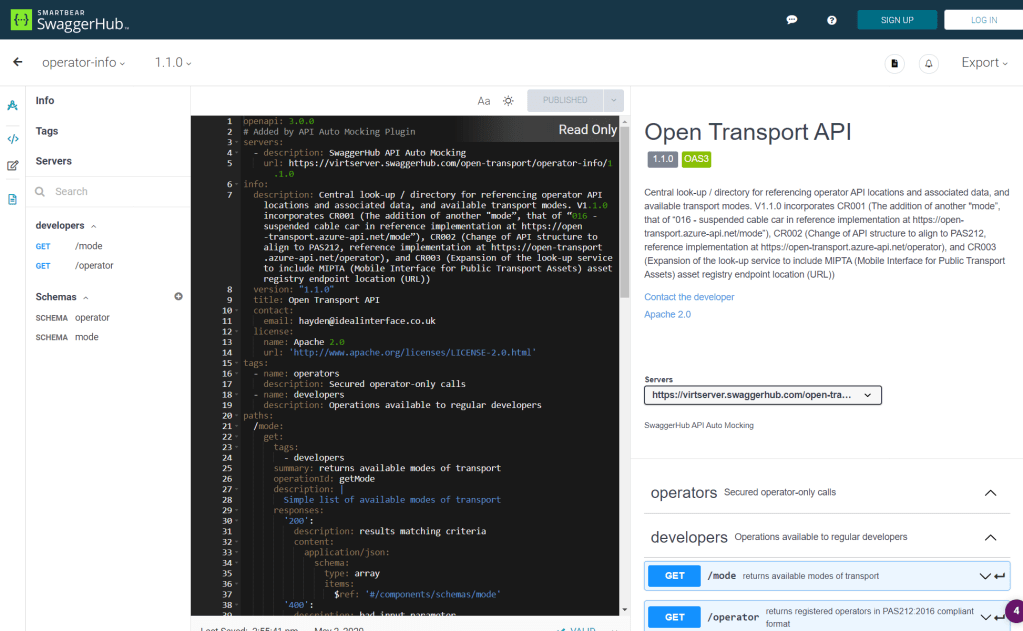
Our Operator-info API specification is the design for a centralised API look-up service for finding the location of data across different Transport operators. Mobility providers and MaaS platforms. A first-of-a-kind technical directory service it allows one Operator’s system to automatically find the latest URL of data (e.g. the Customer-account API) provided by another operator, regardless of transport mode.
https://app.swaggerhub.com/apis/open-transport/operator-info/

Start thinking differently about transport & mobility data

The transport and mobility sector is seeing the benefit of publishing Open Data (data that is made freely available without license or limitation). For example, the release of Open Data by Transport for London (TfL) was calculated by Deloitte as generating annual economic benefits and savings of up to £130m for travellers, London and TfL itself.

Plus Open Data from transport & mobility providers and their platforms can also contribute to improving societal outcomes, encourage innovation and the wider environment. e.g. by changing behaviours and enabling geographic regions to take advantage of new commercial opportunities.

But Open Data is just one type of data and potentially the easiest (or least problematic) to deal with. Sitting on the far right of the Data Spectrum for Transport & Mobility it enables the sharing of data entities such as timetables, fares and routes.

The next challenge is for the sector to understand and work together, in a correct and consistently way, to support the introduction and ongoing management of shared data initiatives, also called Smart Data by the UK Government. Smart Data is defined as that data which is owned by a customer who then gives permission for it to be shared with specific partners – either on a named (one-to-one) basis or on a group-based (less explicitly = depersonalised) basis. This is the data that sits in the middle of the Data Spectrum and requires the use of consent permission & security controls.

But to do this doesn’t just require technology change (e.g. the creation and use of Open API standards for mobility data interoperability), it needs a mindset change to:

  • Introduce legislation to mandate that Smart Data practices are adopted
  • Create the right support entity to help with the implementation of standards and policies
  • Establish sector-wide governance to ensure that processes, data sharing and other societal & commercial considerations (e.g. accessibility, fairness, etc.) are maintained over time

So who will be the first transport authority to think this differently?

Winning ‘Ticketing Enabler of the Year’ at Transport Ticketing Awards

This is a great week for The Open Transport Initiative. Not only have we launched the Data Spectrum for Transport and Mobility to an enthusiastic reception, but we are now also delighted to win Ticketing Enabler of the Year 2021 at the Global Transport and Ticketing Awards.

This is a new category for the Transport and Ticketing Awards this year and was created “to recognise an enabling solution that supports ticketing innovations across the industry.”

The Open Transport Initiative was launched in October 2019 with the purpose of developing and promoting Open Standards for transport & mobility data interoperability. In that short space of time the Initiative has gained a huge amount of momentum and built significant awareness across the sector.

Winning the ‘Ticketing Enabler of the Year’ award adds validation to all the effort that the team have put in over the last 2 years. We hope that this helps to communicate the work of The Open Transport Initiative even further and encourages transport authorities, transport solution providers and Mobility-as-a-Service (MaaS) platforms to adopt our free standards and move the sector towards the complete adoption of customer data interoperability.

Launching The Data Spectrum for Transport & Mobility

Today we launched ‘The Data Spectrum for Transport and Mobility’ in partnership with MaaS Scotland. This follows a detailed piece of work to adapt the Data Spectrum from the Open Data Institute specifically to transport and mobility data.

Further details are available on this page:
https://opentransport.co.uk/the-data-spectrum-for-transport-mobility/

This diagram is a significant step forward in the data maturity of the sector and it is the first to align transport and mobility to data terminology already used by other sectors such as banking, energy, and smart cities.

The Data Spectrum for Transport and Mobility is published under Creative Commons “by SA” license and is free to use and share by all.

If anyone has any feedback or suggestions, they can contact us via:  contact@opentransport.co.uk


Shortlisted for new Transport Ticketing Award

The Open Transport Initiative is delighted to have been shortlisted for the category ‘Ticketing Enabler of the Year’ at the Transport Ticketing Awards.
https://www.transport-ticketing.com/awards-categories/2021-short-list

This is a new category for 2021 and recognises the importance that enabling layers play in the success of transport and mobility services.  

Hayden Sutherland, Founder & Chair of The Open Transport Initiative, stated “I would very much like to thank Transport Ticketing Global for recognising our work in creating and driving forward Open Standards for the sharing of transport & mobility customer data.”

Open, shared and closed data for micro-mobility

Yesterday (27th May 2021) our Founder & Chair Hayden Sutherland gave a talk on “Data standards for micro-mobility providers, authorities & customers” to the Transport Data Initiative.

In this presentation he covered:

  1. The language of data (how terminology is mixed up and confusing)
  2. Definitions for the terms Open Data & Shared Data
  3. The draft Data Spectrum for Transport & Mobility
  4. F.A.I.R Data Principles
  5. A Mobility Data Checklist

The session also had presentations from

  • Innovate UK – UKRI
  • Newcastle University
  • Staffordshire Council

Using data-driven mobility to transform the world

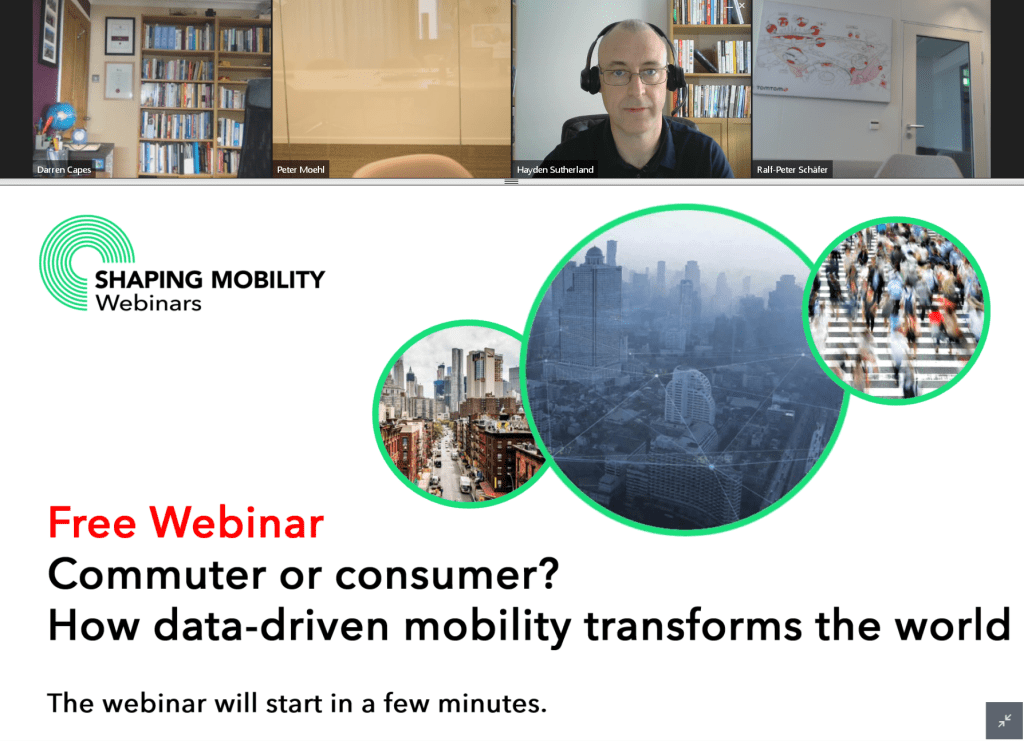
Yesterday (18th May 2021) our Chair & Founder Hayden Sutherland took part in a Shaping Mobility webinar on the topic of “How data-driven mobility transforms the world”. This session, organised and moderated by PTV Group, had input from other respected transport industry specialists from the UK Department of Transport and TomTom.

The topics discussed included:

  • How should authorities use data to optimize mobility?
  • What kind of data fits to which community & transport operator?
  • Can all of us be assured that data of our movements is in safe hands?

Unsurprisingly Hayden mentioned how different types of data from across the Data Spectrum (especially Shared and Open data) can be used to help cities and authorities understand and use mobility data better. But also that data should be made FAIR:
– Findable
– Accessible
– Interoperable
– Reusable

You can watch the entire hour-long video here:

Open Transport & Modal present at Geospatial Data Transport Challenge

Today Open Transport Initiative Founder Hayden Sutherland and Paul Coster, co-founder and CEO of Modal, presented at “Geospatial Data in Transport: A Snapshot of Innovative Projects”. This virtual event showcased innovative projects that were funded through the ‘SBRI: Using Geospatial Data to Solve Transport Challenges Phase 1’ competition. This was the culmination of a £2m fund from the Geospatial Commission, in partnership with Innovate UK, is to support the future of mobility for the UK.

The project we were involved in was a three-month feasibility study, based around the theme of “Enabling Mobility as a Service (MaaS)”, and focused on increasing the number of people that will use MaaS through real-time journey detection and Open Standards.

Here’s what Hayden said:

The Open Transport Initiative has previously worked with a significant number of different transport providers, authorities, MaaS Platforms and software vendors to create the first and only Open Standard API specification for transport & mobility account interoperability.

Based on the same principles as Open Banking, mobility data that is owned by the customer can now be shared across multiple accounts with their permission
(AKA UK Gov “smart data”)

Our standard enables the sharing of purchase data (e.g. tickets), usage (e.g. journeys made) and concessions (e.g. discounts & vouchers) – across any mode of transport – including bus, rail, ferry, taxi, air, parking and micro-mobility.

This project with Modal was the first real-world use of our API specification.

Our joint work on this challenge proved the standard. It also identified an opportunity to update our specification. Leading to a backward compatible change that now allows the richer & more useful exchange of UK Rail ticket data e.g. for better journey detection.

The Open Transport Initiative is now looking forward to the next phase of this challenge. And just today it was announced that up to £4m has been secured to enable the most promising phase 1 projects to progress development & trial solutions.

Make Transport & Mobility Data FAIR

There is a growing awareness of the role and benefits of good data management and usage. Industry, academia, legislators and even day-to-day consumers of digital services now see or receive the advantages of structured, standardised and stewarded information for both humans and machines.

The transport and mobility sector is, like many others, currently going through a huge transformation. Ever-faster technology systems updates & integrations are expected and increasing customer demands for complete and more real-time updates means that data is now a critical business resource for all transport providers, system suppliers and mobility-as-a-service (MaaS) platforms.

But it is no longer good enough to consider structured and stored data as “something the IT Department look after”, every data producer and publisher in a mobility organisation now has a responsibility to ensure that data is F.A.I.R
Findable
Accessible
Interoperable
Reusable

Findability
Data, unlike the Kevin Costner movie is not a Field of Dreams… if you build it (produce / publish data), the don’t come (and find it). Transport data has to be published in such a way that is can be easily discovered by an entire ecosystem.
Many different websites and online lists of mobility data now exist, each describing similar and overlapping data sources and each potentially identifying or describing different versions, potentially with differing timeliness / frequency of data. But websites, although human-readable, are not the best way of helping system-to-system integration of multiple trusted data sources.

What is ideally needed is one directory of data (or more than one, as long as they either cover different data sets or automatically duplicate or reference each other) covering all modes of mobility across an entire transport ecosystem.

In short, what is required is a centralised service, something akin to the Domain Name Service (DNS) used for finding internet websites or the Sort Code system used by the UK banking sector to exclusively identify the persistent location (physical branch and digital address) of each account.

Accessibility
Data is made accessible when the person or system requesting it can do so easily or without unnecessary restrictions. Unfortunately there could be multiple restrictions to getting the data once its location has been found:

  • the data cannot be accessed in a standardised way
  • the technology is restricted (e.g. by propriety protocols and/or licenses)
  • unnecessary authorisation is required (e.g. API keys)

To mitigate this, transport data should be provided via a technology / protocol that is free (no-cost), open (sourced) and thus globally implementable. E.g. HTTP, FTP, REST, etc.
Note: This is not to say that All mobility data should be global and free (perhaps only that data defined as truly Open on the Data Spectrum ), other types of data can and should be limited or monetized as is commercially, ethically, or practically required.

Furthermore, data tends to disappear or degrade over time (typically because there is a cost to hosting and maintaining it). Therefore storing the metadata (e.g. details about the data publisher / owner or the original source location) can be a cheaper or longer-term option

Interoperability
Data works best when it is merged, integrated or used with other data. Making data exchangeable and readable by humans & machines (without needing specialised or clever converters or algorithms) means using common entity definitions, standards or vocabularies across an entire sector or ecosystem, preferably ones also commonly used by the analysts, architects, developers & testers in similar or related sectors.

An obvious example of this for transport & mobility would be to ensure that any technical data interoperability standards created or adopted also take from or align (e.g. easily map) with those used across the location & geospatial sector and the Smart Cities sector.

Reusability
Open Data initiatives have been gaining pace and acceptance across the mobility sector, with transport organisation and authorities publishing easily findable, accessible and (mainly) interoperable data sets online. (Perhaps less so from MaaS Platforms right now… but this will come into effect eventually either by choice or obligation).
Use of this data by others (e.g. external parties for analysis, objective insight and service improvement) has obvious advantages and promotes trust in the data and the publisher. But unlike technical interoperability, where there is the need to ensure as much data as possible works with other data… often it is legally necessary to restrict data usage or prevent freely published data from being subsequently changed or monetised without permission.
It is therefore important that any transport & mobility data source (whether it is Open or Shared / Smart) defines how it can or cannot be replicated and/or combined in different ways, along with a clear data usage / re-usage license.