If messaging apps are being made interoperable, why not transport accounts?

The European Union has announced plans for a new Digital Markets Act (DMA) that could force changes at the big technology companies and legislate for them to make their messaging apps talk to each other.

Announced back at the end of March the DMA plans to ban certain practices by these “gatekeeper” companies (such as social networks or search engines with a market capitalisation of at least 75 billion euro or an annual turnover of 7.5 billion) who the EU says are most prone to these unfair business practices.

This means they could soon be forced to enable customers using one messaging app to send their messages to contacts who use other apps. For example, it would make it possible to send a message using Apple iMessage to another person using WhatsApp. Or someone on Google Hangouts (soon to be replaced by Google Chat) to message a friend on Facebook Messenger.

This message app interoperability and standardisation has been met with support by many in the sector, as this could mean an eventual move away from text-only SMS. It would also reduce barriers to market entry, as the big players would have to open up and work with smaller messaging platforms that requested it.

So if the messaging market is the next target for interoperability… when will transport and mobility accounts be able to integrate and share data?

Back in September 20202 the UK Government published the report titled “Next steps for Smart Data. Putting consumers and SMEs in control of their data and enabling innovation”.

In this document it cites the success of Open Banking and that UK Parliament will introduce primary legislation to make different sectors participate in Smart Data initiatives. But most importantly that this will extend to sectors such as retail and transport.
https://opentransport.co.uk/2020/09/21/open-transport-welcomes-legislation-to-mandate-transport-industry-participation-in-smart-data-initiatives/

So yes this does meant that, at the right time, there will be legislation created to make this shift happen. Assumed to be similar to the legislation used on the UK Banking sector several years ago, it is expected to insist that key transport authorities and mobility providers make their accounts able to share customer data via Open Standard APIs.

So hopefully, one day… we will have the same sort of interoperability between customer accounts for major transport providers, regional authorities and Mobility-as-a-Service platforms, as the EU is proposing between messaging Apps from Facebook, Google and Apple.

Photo credit: https://unsplash.com/@the_average_tech_guy
What Data Sharing is needed for MaaS?

The implementation and ongoing governance of Mobility-as-a-Service (MaaS) needs to provide clear and firm guidance on what and how data is shared across a transport ecosystem.

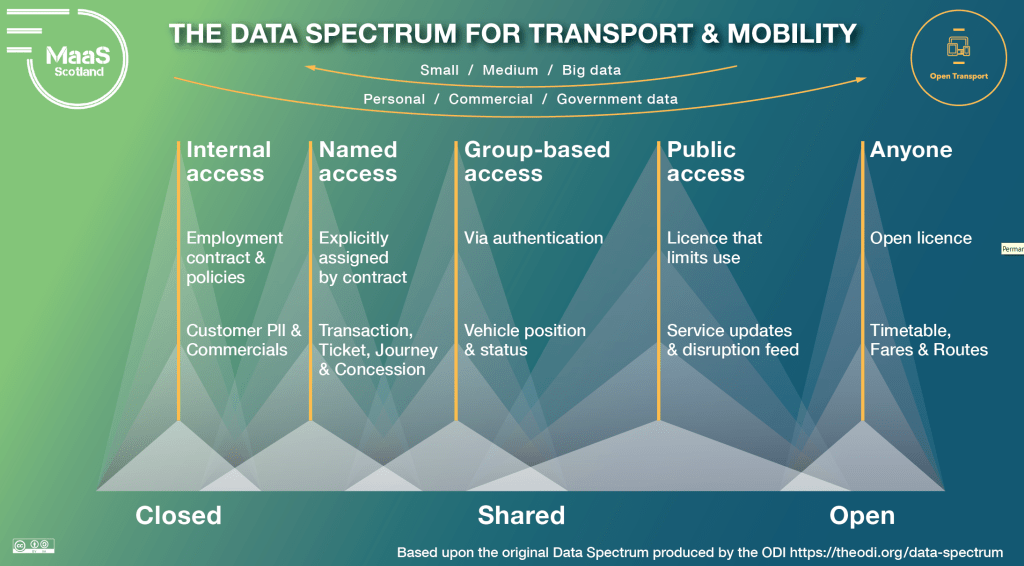
But data sharing, the specific sharing of data from the middle of The Transport & Mobility Data Spectrum (therefore not Open Data and not Closed Data) actually covers a range of different data types.

These are:

Named Access (“Smart Data” as the UK Government describes it)
This is when the customer gives specific approval for some/all of their data, typically in an account they manage, to be securely shared with a specific third-party account or provider – e.g. how Open Banking works. Back in Sept 2020 the UK Gov announced its intentions to extend the reach of current Smart Data legislation to other sectors, including Transport: https://opentransport.co.uk/2020/09/21/open-transport-welcomes-legislation-to-mandate-transport-industry-participation-in-smart-data-initiatives/

Group-based Access
This is data that Transport Authorities and Organisations within the ecosystem share between each other for transport planning and operations purposes. The best example of this data type is the Mobility Data Specification run by the Open Mobility Foundation (https://www.openmobilityfoundation.org/), which is a data standard that helps cities manage and monitor micro-mobility companies

Public Access
This is data that is similar to Open Data (in that it does not need restricted access) but does have some license limitations – e.g. it cannot be changed, enriched with other sources, resold, etc. without permission.

Shared mobility needs shared data

Newer modes of transport such as ebikes & escooters and more modern Mobility-as-a-Service (MaaS) schemes must be accessible and usable to as many different people as possible to fulfil their potential.

But what about the data these new mobility services create? Is this data findable? Is this data accessible? Is the data in each of the accounts created by these services able to be freely exported and shared?

Shared transport and mobility data sit in the middle of the Data Spectrum

In most cases the answer is no, the transport and mobility data stored in each service is only for use by that service. It is not portable, sharable or able to be integrated with others – either via named access or group access [see The Data Spectrum for Transport & Mobility].

This lack of customer account data sharing (known as Smart Data by the UK Government) is a limitation of nearly every transport service. It is a restriction that is either done purposefully (to stop users migrating to another solution) or unknowingly (as transport providers are unaware that they need to specify such account interoperability functionality into the systems they procure and pay handsomely for).

So, in the same way that transport authorities are encouraged to adopt new transport modes or evolve towards shared mobility services, they also must now be educated and even incentivised to adopt new consumer data sharing practices too.

Public transport & transit needs data interoperability

Public transport and transit providers have been trapped in walled gardens of data and technology. In short they are held captive by the very vendors who build their systems for them, but rely on closed and proprietary standards & architectures, rather than open and flexible ones.

These monopolistic practices stifle competition and innovation, both by preventing new entrants from easily integrating their solutions and by stopping data being portable from one system to another.

Transit agencies and public transport providers can now avoid this vendor lock-in by insisting their systems are interoperable and built upon open standards. By making sure that any retail, ticketing and customer account products now use technology based upon Open APIs, they can make their systems more future-proof and eventually able to be part of a wider transport and mobility ecosystem.

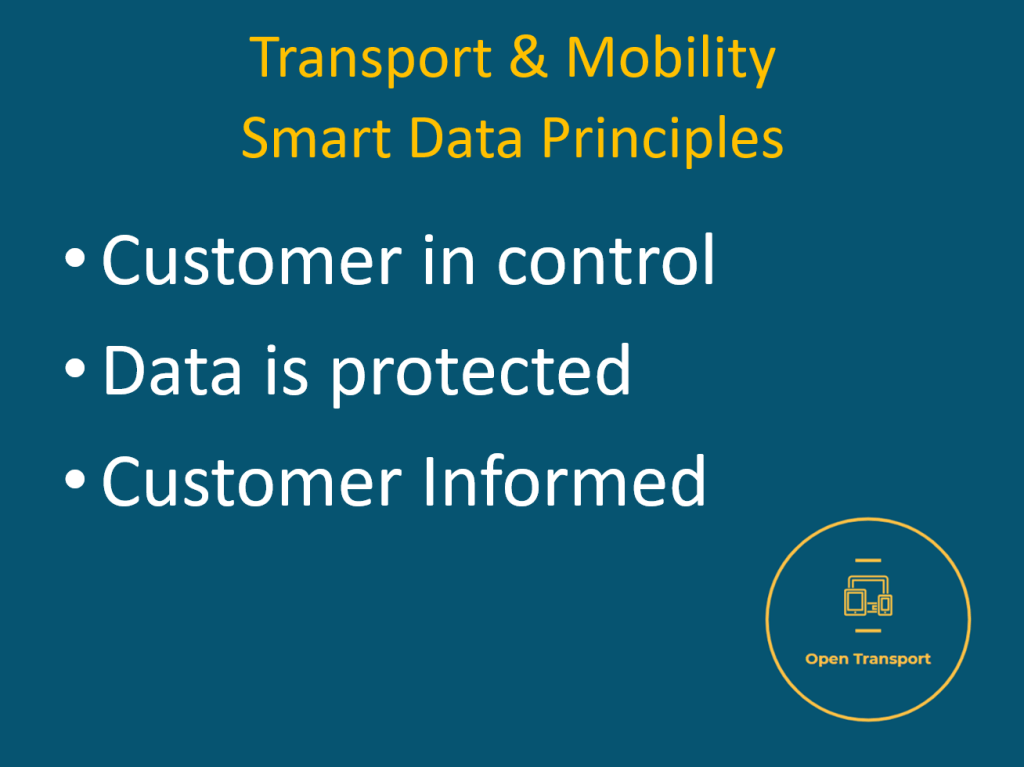
Transport & Mobility Smart Data Principles

We are industry advocates for the adoption and use of Smart Data – transport & mobility customer account data that is shared with permissions – and believe that a truly interoperable transport ecosystem is only possible if a customer’s mobility data is portable too.

We therefore believe that the following key principles should underpin any data sharing framework:

  • Customers have full control over their own account data – including the ability to export, share with third parties and delete (where allowed) this data
  • Customer data is protected, meaning it only shared with those third parties they give permission for and with the necessary security and data controls
  • Customers are informed of any conditions or barriers to accessing and sharing their data upon account creation (and subsequent changes)

What other principles have we missed? contact@opentransport.co.uk

Standardising transport & mobility mode definitions

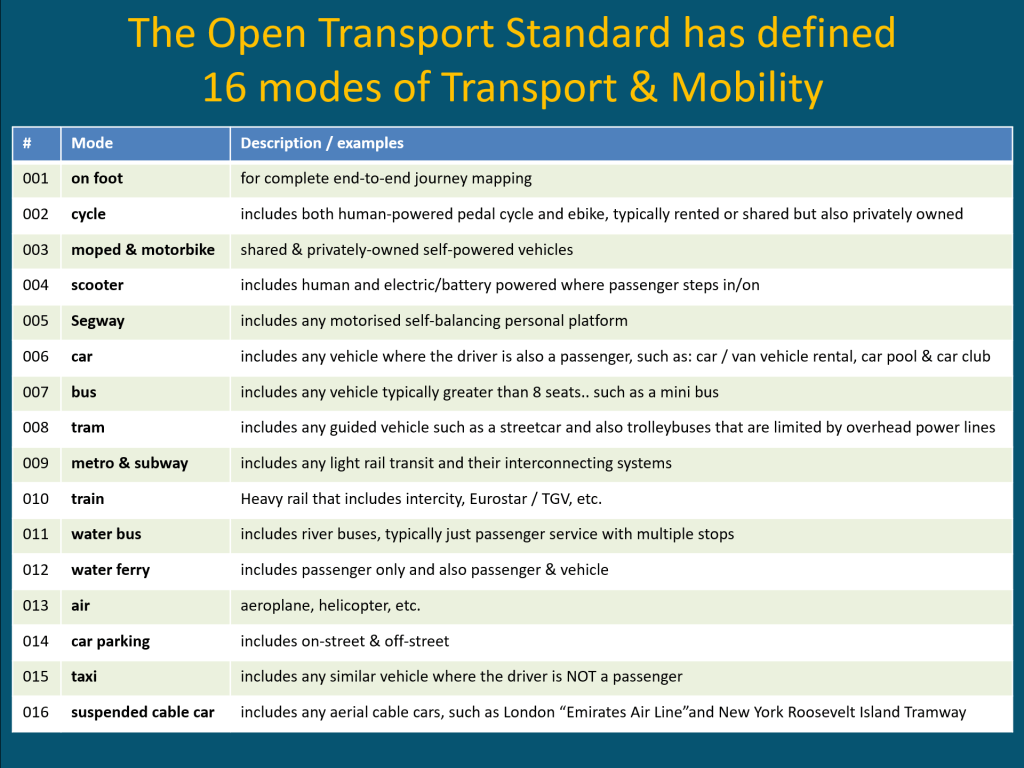
In our efforts to create Open Standards for transport & mobility account data interoperability, The Open Transport Initiative has obtained input from 30+ different: transport providers, MaaS platforms, suppliers and specialists across Europe.

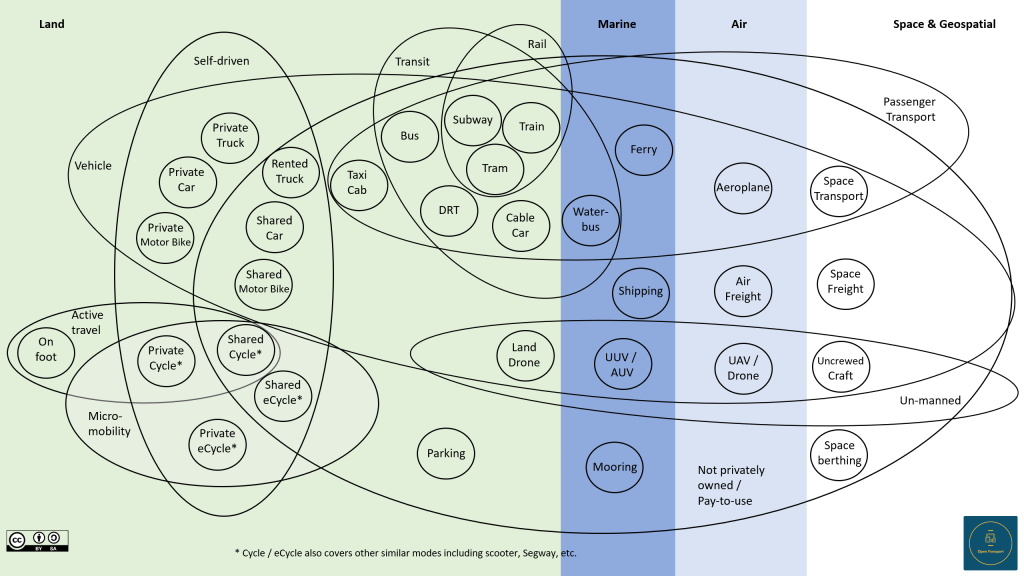
This has resulted in us defining 16 modes of transportation and conveyance with the following descriptions & examples:

We believe that this list (currently at 16 in number) covers most, if not all, modes of transportation used across a mobility ecosystem.

If you think we have missed one, please contact us: contact@opentransport.co.uk

Could transport & mobility accounts become obsolete? Interview with our Founder

In a recent article initially posted on Linkedin, Hayden Sutherland, the Founder and Chair of The Open Transport Initiative, proposed the concept that transport & mobility accounts could become obsolete, as FinTech accounts are the more logical place for handling the financial processing of transport data.

Titled “Could FinTech kill the transport & mobility account?” the article explains that creating & on-boarding a bank account (or a sub-account) in an online banking app is now easier than registering for yet another new account with each different transport supplier or Mobility-as-a-Service (MaaS) platform.
https://www.linkedin.com/pulse/could-fintech-kill-transport-mobility-account-hayden-sutherland/

Following-up on this, Open Future World, the global online source of open banking, open finance and wider open economy information, quizzed Hayden about the points made and the impact such an approach could have.

This interview is now available here:
https://openfuture.world/are-fintechs-the-future-for-financial-processing-of-transport-data/

Map of Transport & Mobility Modes – Updated for COP26

The transport and mobility sector has a fundamental role in tackling climate change. As the second largest emitter of Greenhouse gasses (mainly CO2) it has a major responsibility to protect our planet.

Therefore The Open Transport Initiative was incredibly proud to have been invited to present our updated “Map of Transport & Mobility Modes” at the COP26 “Future of Transport” event yesterday.

The below diagram now includes “Space & Geospatial” modes, including: passenger space transport, space freight, un-crewed spacecraft and off-planet berthing.

It is published under a Creative Commons license for all to use.

Open Transport Initiative at COP26

If you are a delegate or participating at COP26 today, you can see a session run by Hayden Sutherland, our Founder & Chair. This session called “What is Transport” is part of the Future of Transport event, in the KTN Space & Geospatial Virtual Pavilion for COP26.
https://ktn-uk.org/events/space-geospatial-virtual-pavilion/

During this interactive session Hayden will present a map of different transport & mobility modes. This diagram is an updated version of one previously designed by The Open Transport Initiative that now includes different Space & Geospatial” modes of transport and mobility.

Published under Creative Commons license, this updated diagram will be free for all to use.

The Lack of Mobility Customer Data Governance Has a Lasting Impact

Organisations in every sector must abide by some form of rules and regulations. Whether these are Health & Safety, employment, competition, taxation or just the legal constraints of existing in a modern civilised society… every one of them is governed in some way to protect their customers, staff or the wider economy.

So unsurprisingly there are a lot of rules covering different modes of transport:
Buses have to be road-worthy. Trains have to stop in the right places. Ferries have to be water-tight. Seatbelts have to be worn by all car occupants. And even cable cars require their own legislation to allow them to be permitted, policed and issue penalty fares issues.

There are also many laws about the storage, use and transmission of customer data. In fact, most UK adults will now have some awareness of data security rules and compliance (e.g. by using something as simple as a password to lock access to their mobile device) and big companies are increasingly aware of the threat of cybercrime and data loss.

But in the virtual Venn diagram that intersects both customer data and transport & mobility standards, there are very few specific rules and even fewer open data standards.

This means that questions in this area go unanswered, such as:

  • Where does customer ticket data reside and who has access to it?
  • How can new tech providers and value-added mobility services integrate accounts into an existing ecosystem?
  • What happens when a customer lives within the jurisdiction of one transport authority but works in another, but wants to have a consolidated view of all their journeys?
  • What happens when a customer wants to unregister with an account based ticketing service and be forgotten?
  • What happens when there are different technical options for account integrations and a decision on which to take is required?

This lack of customer data governance is holding back the transport and mobility sector. Other sectors such as banking, finance, healthcare and energy have all mobilised to enable customer account data sharing across different suppliers and technologies. Creating frameworks and blueprints for the adoption of data interoperability BEFOE legislation is created that mandates such actions.