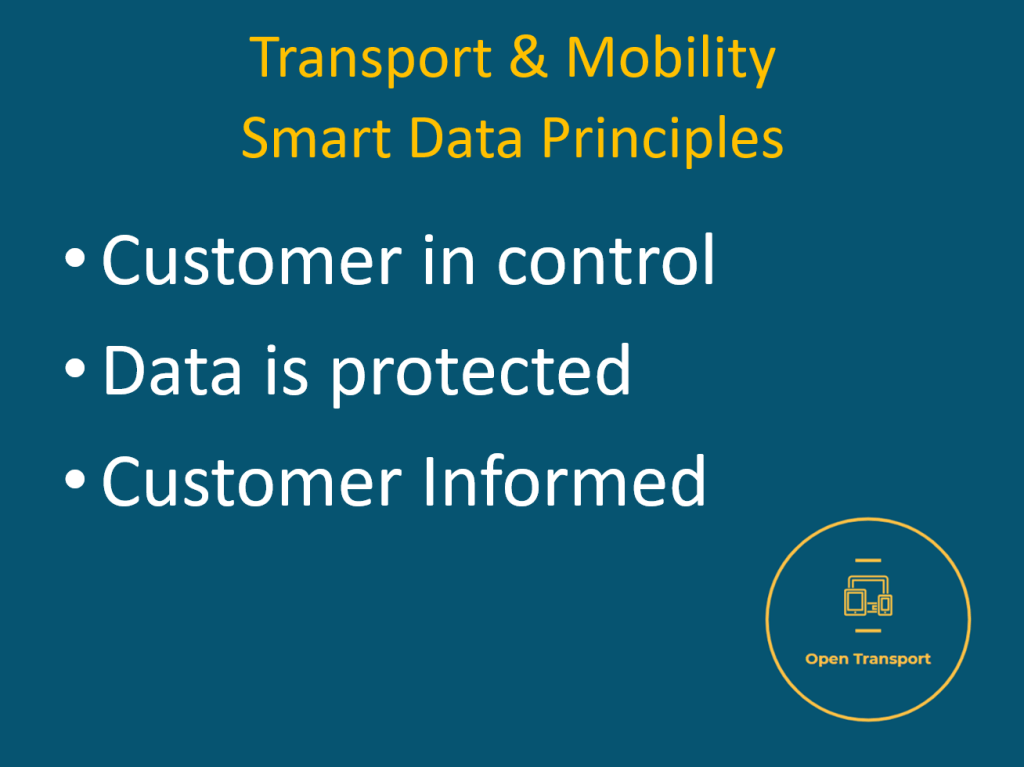
Transport & Mobility Smart Data Principles

We are industry advocates for the adoption and use of Smart Data – transport & mobility customer account data that is shared with permissions – and believe that a truly interoperable transport ecosystem is only possible if a customer’s mobility data is portable too.

We therefore believe that the following key principles should underpin any data sharing framework:

  • Customers have full control over their own account data – including the ability to export, share with third parties and delete (where allowed) this data
  • Customer data is protected, meaning it only shared with those third parties they give permission for and with the necessary security and data controls
  • Customers are informed of any conditions or barriers to accessing and sharing their data upon account creation (and subsequent changes)

What other principles have we missed? contact@opentransport.co.uk

Standardising transport & mobility mode definitions

In our efforts to create Open Standards for transport & mobility account data interoperability, The Open Transport Initiative has obtained input from 30+ different: transport providers, MaaS platforms, suppliers and specialists across Europe.

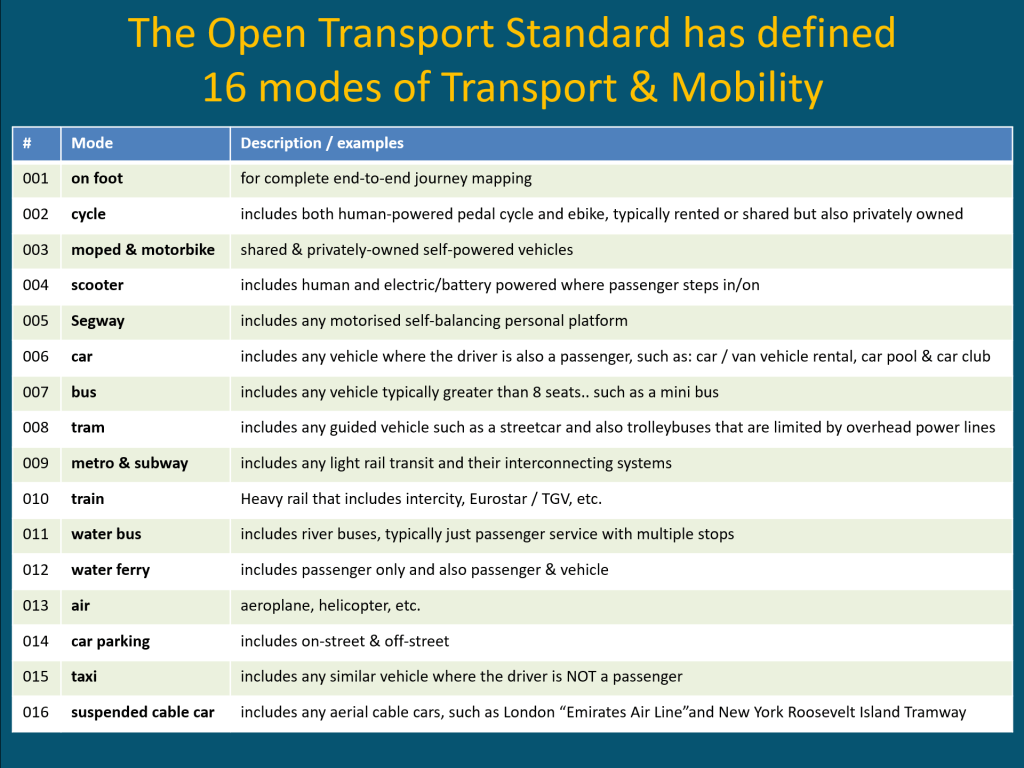
This has resulted in us defining 16 modes of transportation and conveyance with the following descriptions & examples:

We believe that this list (currently at 16 in number) covers most, if not all, modes of transportation used across a mobility ecosystem.

If you think we have missed one, please contact us: contact@opentransport.co.uk

Could transport & mobility accounts become obsolete? Interview with our Founder

In a recent article initially posted on Linkedin, Hayden Sutherland, the Founder and Chair of The Open Transport Initiative, proposed the concept that transport & mobility accounts could become obsolete, as FinTech accounts are the more logical place for handling the financial processing of transport data.

Titled “Could FinTech kill the transport & mobility account?” the article explains that creating & on-boarding a bank account (or a sub-account) in an online banking app is now easier than registering for yet another new account with each different transport supplier or Mobility-as-a-Service (MaaS) platform.
https://www.linkedin.com/pulse/could-fintech-kill-transport-mobility-account-hayden-sutherland/

Following-up on this, Open Future World, the global online source of open banking, open finance and wider open economy information, quizzed Hayden about the points made and the impact such an approach could have.

This interview is now available here:
https://openfuture.world/are-fintechs-the-future-for-financial-processing-of-transport-data/

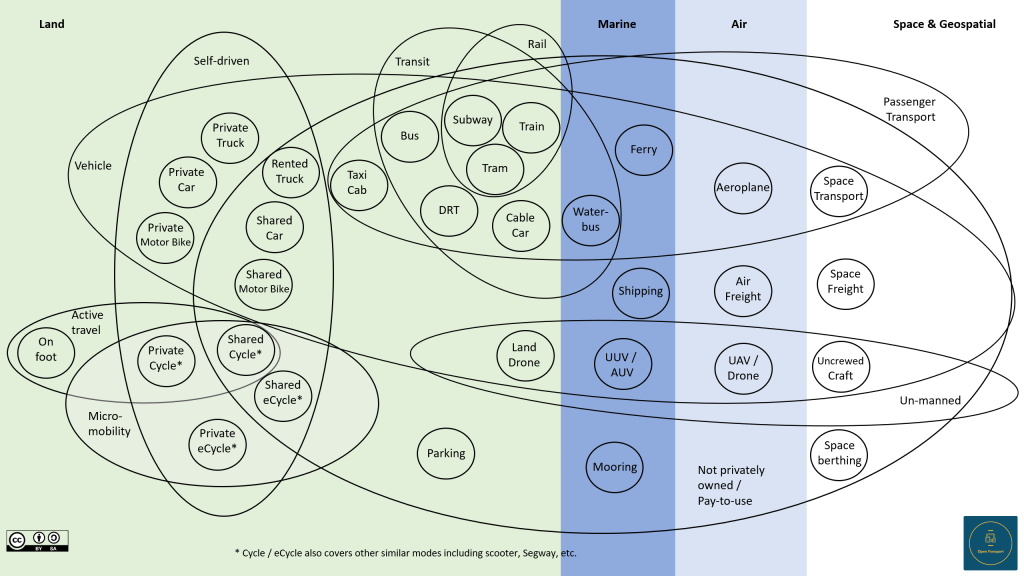
Map of Transport & Mobility Modes – Updated for COP26

The transport and mobility sector has a fundamental role in tackling climate change. As the second largest emitter of Greenhouse gasses (mainly CO2) it has a major responsibility to protect our planet.

Therefore The Open Transport Initiative was incredibly proud to have been invited to present our updated “Map of Transport & Mobility Modes” at the COP26 “Future of Transport” event yesterday.

The below diagram now includes “Space & Geospatial” modes, including: passenger space transport, space freight, un-crewed spacecraft and off-planet berthing.

It is published under a Creative Commons license for all to use.

Open Transport Initiative at COP26

If you are a delegate or participating at COP26 today, you can see a session run by Hayden Sutherland, our Founder & Chair. This session called “What is Transport” is part of the Future of Transport event, in the KTN Space & Geospatial Virtual Pavilion for COP26.
https://ktn-uk.org/events/space-geospatial-virtual-pavilion/

During this interactive session Hayden will present a map of different transport & mobility modes. This diagram is an updated version of one previously designed by The Open Transport Initiative that now includes different Space & Geospatial” modes of transport and mobility.

Published under Creative Commons license, this updated diagram will be free for all to use.

The Lack of Mobility Customer Data Governance Has a Lasting Impact

Organisations in every sector must abide by some form of rules and regulations. Whether these are Health & Safety, employment, competition, taxation or just the legal constraints of existing in a modern civilised society… every one of them is governed in some way to protect their customers, staff or the wider economy.

So unsurprisingly there are a lot of rules covering different modes of transport:
Buses have to be road-worthy. Trains have to stop in the right places. Ferries have to be water-tight. Seatbelts have to be worn by all car occupants. And even cable cars require their own legislation to allow them to be permitted, policed and issue penalty fares issues.

There are also many laws about the storage, use and transmission of customer data. In fact, most UK adults will now have some awareness of data security rules and compliance (e.g. by using something as simple as a password to lock access to their mobile device) and big companies are increasingly aware of the threat of cybercrime and data loss.

But in the virtual Venn diagram that intersects both customer data and transport & mobility standards, there are very few specific rules and even fewer open data standards.

This means that questions in this area go unanswered, such as:

  • Where does customer ticket data reside and who has access to it?
  • How can new tech providers and value-added mobility services integrate accounts into an existing ecosystem?
  • What happens when a customer lives within the jurisdiction of one transport authority but works in another, but wants to have a consolidated view of all their journeys?
  • What happens when a customer wants to unregister with an account based ticketing service and be forgotten?
  • What happens when there are different technical options for account integrations and a decision on which to take is required?

This lack of customer data governance is holding back the transport and mobility sector. Other sectors such as banking, finance, healthcare and energy have all mobilised to enable customer account data sharing across different suppliers and technologies. Creating frameworks and blueprints for the adoption of data interoperability BEFOE legislation is created that mandates such actions.

Geospatial Commission recognises value of Transport Data

The UK Geospatial Commission has recently published a report titled “Positioning the UK in the fast lane, Location data opportunities for better UK transport”
https://www.gov.uk/government/publications/positioning-the-uk-in-the-fast-lane-location-data-opportunities-for-better-uk-transport

This report highlights key common themes and crosscutting challenges, based on six transport use cases, where geospatial product and services could unlock greatest benefit.

  1. Treating mobility as an interconnected system:
    We will need to have a common location data framework for defining our transport networks.
  2. Data interoperability and standards:
    Standards must be implemented in the way that transport location data is collected, stored and managed.
  3. Making data more findable and accessible:
    Data must be made more discoverable and easier to access.
  4. Improving data reuse:
    Data is rarely useful for a singular purpose and must be made available for reuse where possible.
  5. Enabling greener modes of transport:
    We will need to transform the sector in order to meet the UK’s commitments around
    achieving net zero by 2050.
  6. Unlocking the potential for data-driven innovation in transport:
    Organisations will need access to capital, skills and ideas, as well as a smart and stable regulatory framework to support data-driven innovation.

These 6 themes very closely align with the aims of The Open Transport Initiative to ensure that transport & mobility data is F.A.I.R (Findable, Accessible, Interoperable & Reusable).

Although there was no mention of encouraging all transport providers & Mobility-as-a-Service (MaaS) platforms to adopt smart data sharing standards, therefore allowing customer account data to be portable… the first step of making transport location data sharable across an entire transport ecosystem is a positive move for our sector.

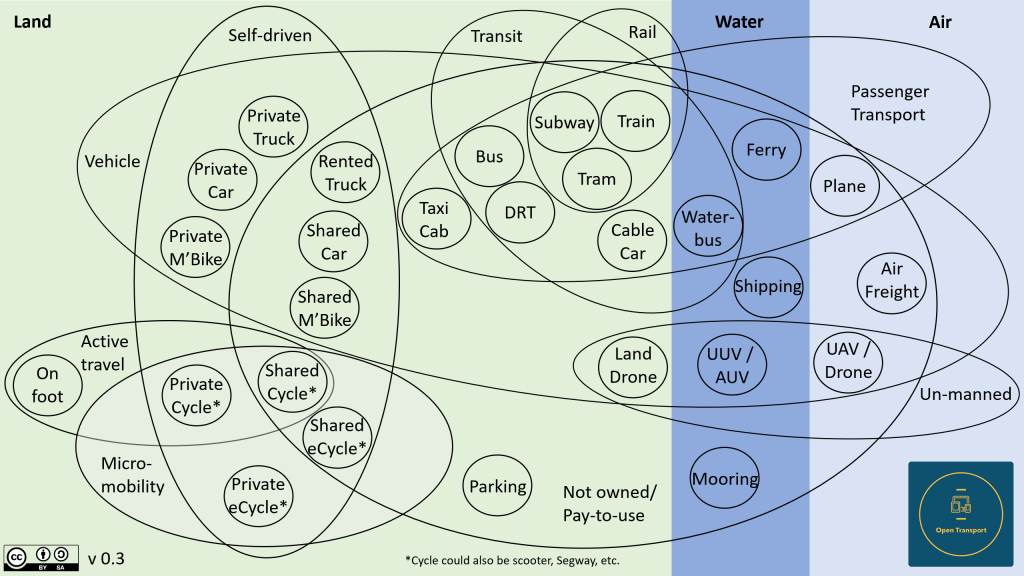
Mapping transport & mobility modes

Some readers of this blog may be aware that we have spent some some back in 2019 defining the different modes of transport & mobility. These also have been mapped / compared to both the Mobility Data Specification (MDS) and General Transit Feed Specification (GTFS).

Our first attempt at defining our own mode classifications aligned very closely to the TOMP-API specification’s definitions, so we merged that work into our own (and added a few more modes on top). Since then we have used this definition of the basis of our “Customer-Account” data sharing specification and also our “Operator-Information” API specification… leading to us launching this as an actual sector-specific directory for making shared / smart transport data more findable.

However, we have more recently been engaging with other organisation & bodies, to further align our data standards work with different sectors including: smart cities, business transport and freight.

This has led us to design a map of all transport & mobility modes that shows their different classifications and categories. And the above diagram shows our current draft version (v0.3), based upon feedback from several online forums and discussion areas.

Please let us know what you think, if our categorisation is correct and what modes we may have missed: contact@opentransport.co.uk

Central Mobility Operator Directory launches

We have some great news to share… the launch of our Central Mobility Operator Directory. Here’s lead developer David O’Neill explaining the project in more detail…

Over the last 6 weeks, I have been working in partnership with the Open Transport Initiative to produce a live operator directory, in line with the operator-info API specification
The first stage of the project was to choose the correct technology to build and host the API in order to meet the non-functional requirement of scalability. We agreed to begin development with Flask, the Python framework – code can be found at: https://github.com/DavidONeill75101/open-transport-operator-api

The Open Transport Initiative identified a spreadsheet as an appropriate tool to store the operator data, providing simple access which required no programming knowledge. As a result, the API was configured to pull data from the spreadsheet using pandas, the Python library, to manipulate it and return the necessary JSON

Once the build stage was complete, our efforts moved onto hosting the API. AWS Elastic Beanstalk was chosen as an effective tool as it automatically provided the necessary auto-scaling and load balancing to meet non-functional requirements. We ensured that the API was configured to scale successfully to meet the demands of spikes in traffic and continue to monitor how it handles many requests.

After deliberation, we opted to register a domain with the “.com” TLD instead of “.co.uk”. We
agreed that this was the correct move since the API could be adopted internationally, while also routing queries down the path /uk. Finally, we configured the domain to run over https ensuring that all data is encrypted in transit.

The directory is now live at https://www.otidirectory.com and we hope that this project will be embraced as an industry standard.

The 1st Central Operator Service for Transport & Mobility

Released at the same time as the “customer account” API specification in early 2020, our “central operator” Open Standard became the first (and only) look-up specification to enable shared data (AKA smart data) sources to be found across all modes of transport within an entire mobility ecosystem.

Subsequently, after feedback from various organisations, we updated and aligned this Open Standard to a wider Internet-of-Things (IoT) data discoverability Open Standard (PAS212).

However, since then not much has been done with it. Until now… as we have made the decision to build and release a fully working central directory for the discovery of shared transport & mobility data.

Background
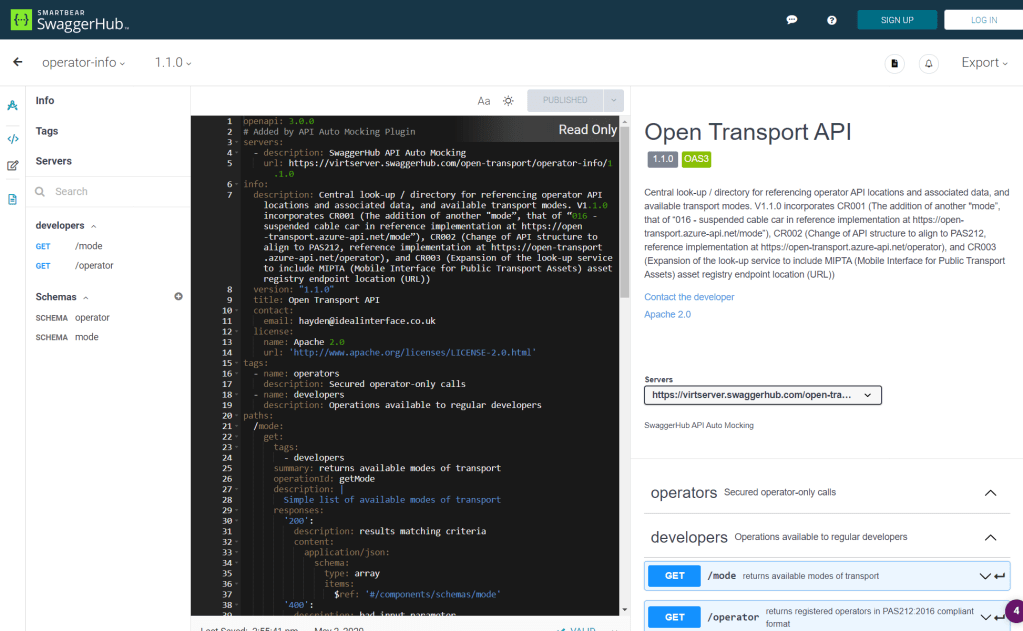
Our Operator-info API specification is the design for a centralised API look-up service for finding the location of data across different Transport operators. Mobility providers and MaaS platforms. A first-of-a-kind technical directory service it allows one Operator’s system to automatically find the latest URL of data (e.g. the Customer-account API) provided by another operator, regardless of transport mode.
https://app.swaggerhub.com/apis/open-transport/operator-info/