Shared and Decentralised Transport & Mobility Data

Our work on creating and managing the only customer account data sharing standard for transport & mobility (otherwise known as the Open Banking standard for transport) enables a customer’s mobility data to be shared with other Third Party Providers (TPP) via an Open Standard API: https://opentransport.co.uk/open-standard/

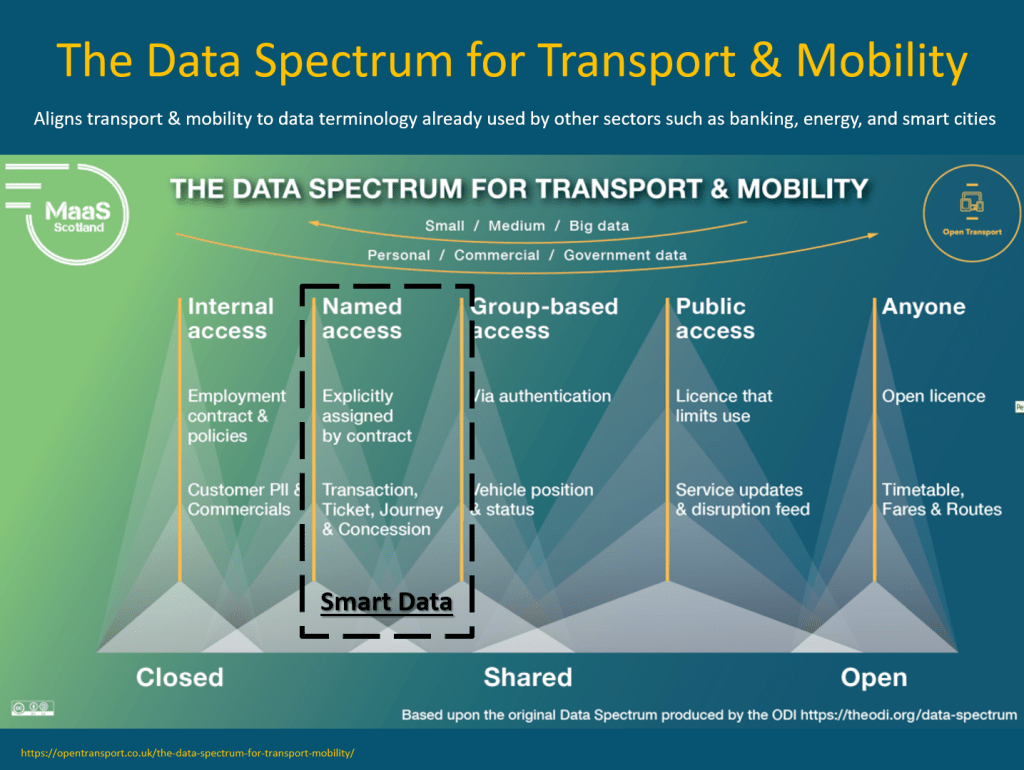
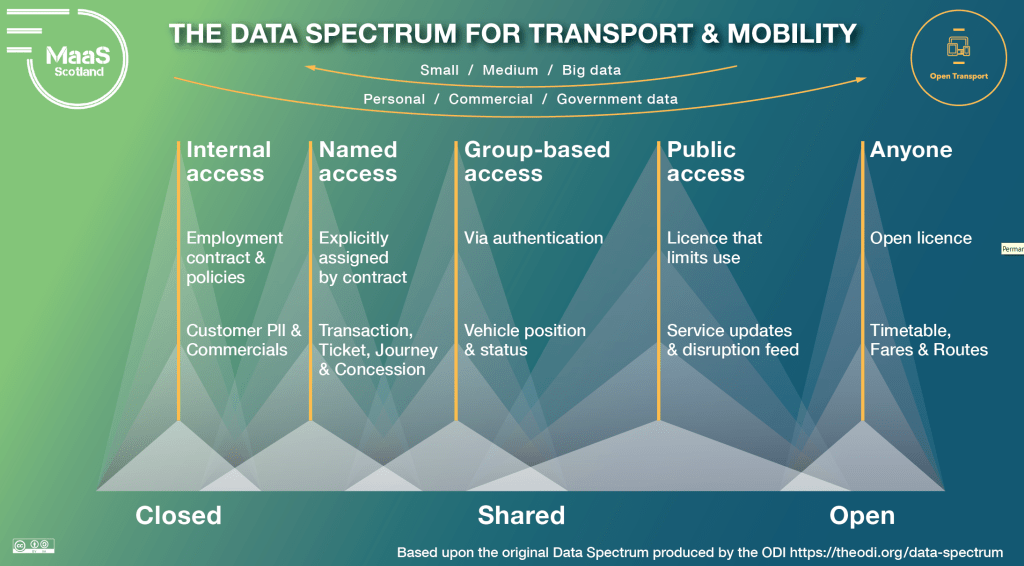
This integration of data is known as Smart Data by the UK Government and it sits in a specific area the Data Spectrum for Shared Data:

When fully implemented, this approach would allow customer mobility account interoperability across an entire transport ecosystem (e.g. a city, a geographic region or even an entire country). Allowing the travelling user to consolidate and view all their different transport products / purchases, journeys and entitlements data in a single place… the account or TPP of their choosing.

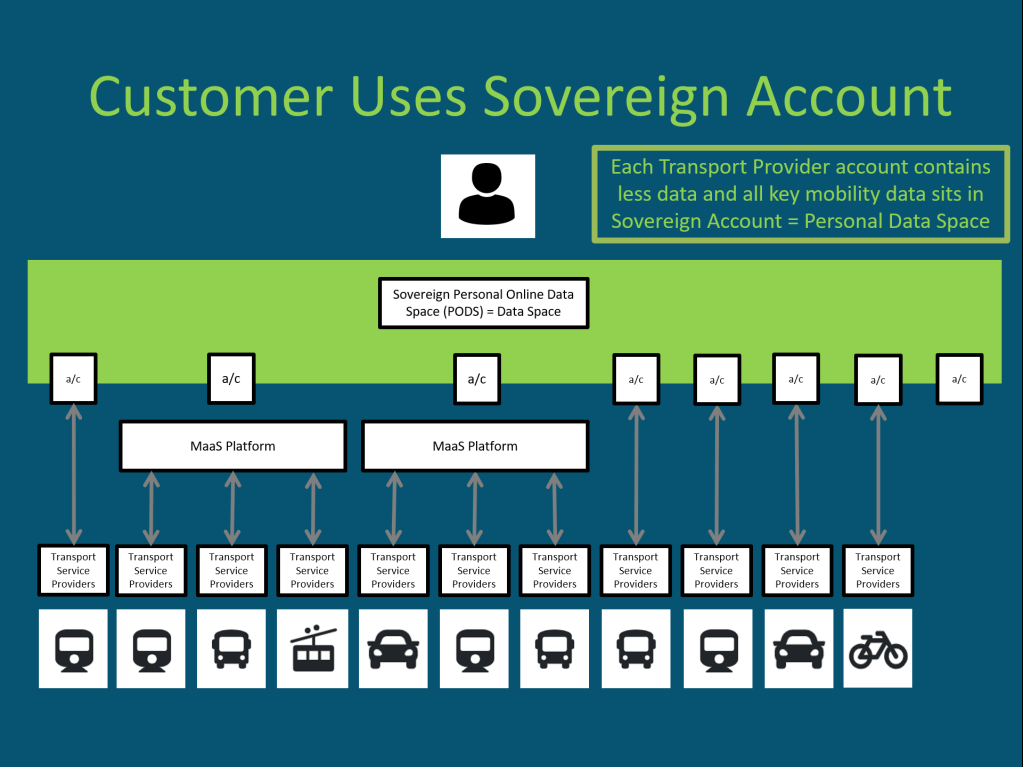
In an earlier post we also explained that, although similar to Shared / Smart Data, Decentralized or Sovereign data is different… in that personal data (including products / purchases, journeys and entitlements) does not reside in many different accounts across the ecosystem. Instead this data sits outside of each Transport Provider’s account and in a Sovereign account controlled / managed by the customer. Then, in a process similar to mobile phone account roaming, the user can (automatically or manually) grant each party in the ecosystem access to just the data they require.

The implementation of such an approach would result in the creation of Personal Online Data Spaces [PODS] for the sector, also known for as individual Mobility Data Spaces.

Why “good enough” data sharing practices are not good enough

The UK Transport & mobility sector seems to have settled on a “good enough” approach to data sharing and interoperability.

This amounts to a reverse tragedy of the commons scenario across the sector, where every transport provider or authority deliberately under-invests in their own data sharing technology capabilities, as they see no point working for the collective good by making their systems more interoperable and sharable… because none of the other actors with the ecosystem are doing the same.

This creates the situation where the consumer of those services may not even be aware of the potential of a better mobility service and where the transport providers look for incremental revenue for themselves in non-data ways. Plus the transport providers in that ecosystem become accustomed to this technological stalemate, even if it could mean less potential revenue for the entire sector or a lack of overall innovation driven by data.

However we think this is the tragedy and that more needs to be done to encourage and force data sharing across the sector e.g. Open Data, Shared (and therefore limited by license), but especially that part of the data spectrum that makes named access customer data more sharable from provider to provider. To do this requires an ecosystem-wide strategy and implementation approach, where all players are encouraged or mandated to increased their own data sharing capabilities.

Open Transport presents at OpenX

Today, our Founder Hayden Sutherland was invited to present at the inaugural OpenX Congress (https://www.openxcongress.com) run by https://openfuture.world – This was a 2 day event that covered the evolution from Open Banking to Cross-sector data sharing ecosystems.

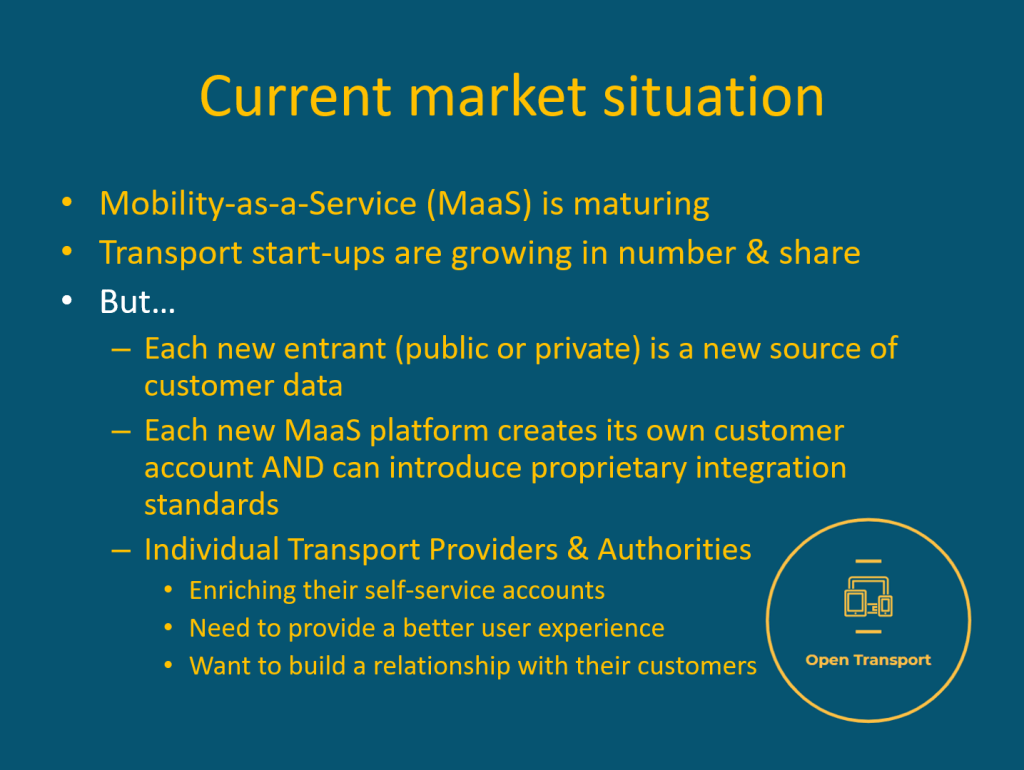
During his presentation, Hayden explained about the complexities and intricacies of the fragmented UK transport & mobility sector and the newer challenges it faces as cities & regions race to adopt new account-based Mobility-as-a-Service (MaaS) systems… that create further silos of customer data.

And how individual transport providers and regional authorities & cities are still building and scaling-up their own “walled gardens” self-service accounts… with none of them interoperable with each other.

Hayden also went on to explain about how current GDPR “Rights of the Individual’ to data portability are currently ignored. And that Smart Data Government legislation, hopefully due sometime in the near future, should eventually facilitate the sharing of customer data across the transport & mobility sector.

CountEmissions EU creates a path to Net Zero for Transport & Mobility

The “CountEmissions EU” is an initiative that will offer a framework for calculating transport and logistics-related door-to door greenhouse gas (GHG) emissions in a consistent way, regardless of transport mode, sector or country of operation.

The general objective of this initiative is to incentivise the reduction of emissions from transport and logistics,
through:

  • establishing a level playing field for GHG emissions accounting in the transport and logistics sectors
  • facilitating behavioural change.

The expectation is that this will improve the environmental performance of transport through specific objectives:

  • providing a single EU framework for calculating GHG emissions data of transport operations/services
    in freight and passenger sectors
  • making available reliable and comparable information on the GHG intensity of individual transport
    services
  • facilitating the uptake of GHG emissions accounting in business practice.

We would therefore advise any organisation looking to see a consistent way of calculating and reporting GHG emissions across transport and logistics to add their thoughts and inputs.

Since Transportation is currently responsible for around 20% of all global CO2 emissions….
https://opentransport.co.uk/2020/11/09/joined-up-transport-data-has-net-zero-role/

… our hope is that this initiative will introduce a standard way of comparing data for both organisational and individual GHG emissions, creating greater transparency and enabling better emissions reporting, therefore leading to a reduction in global warming caused by the transport & mobility sector.

MaaS Account Roaming Needs Data Sharing Standards

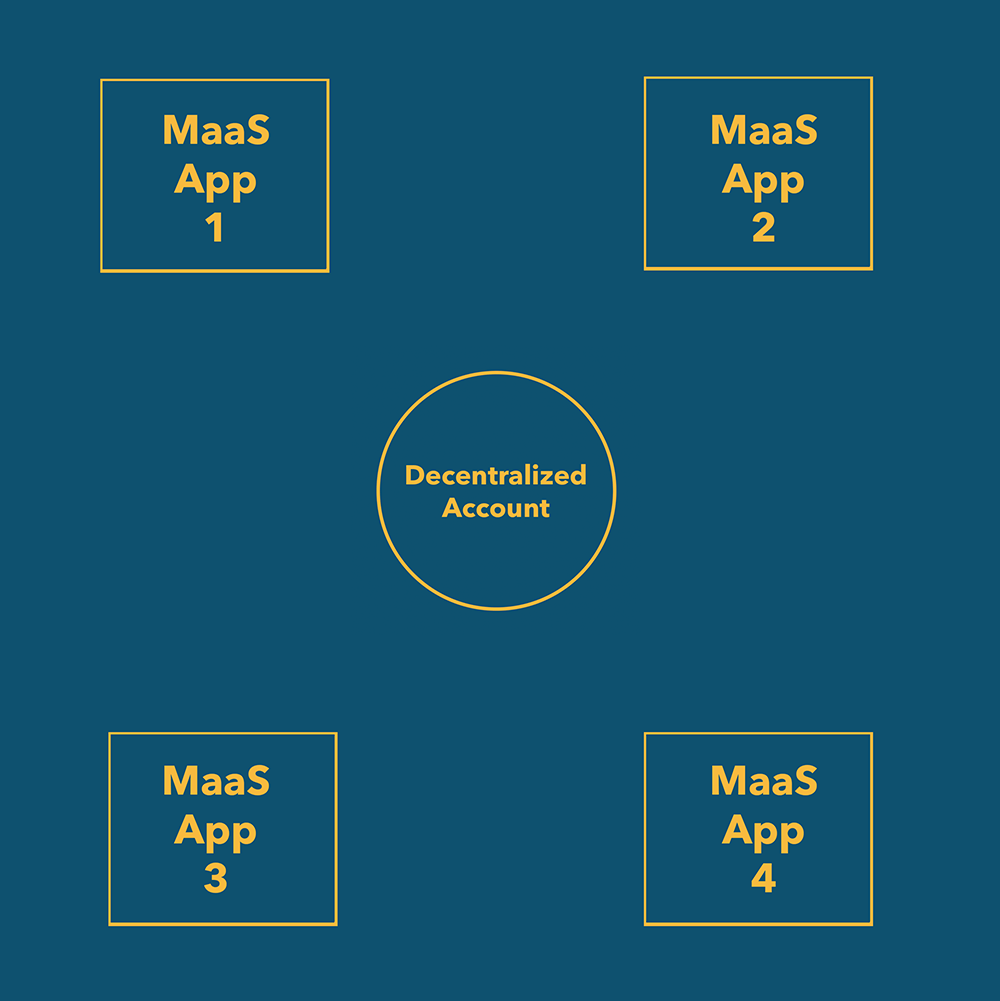
Personal Account Roaming for MaaS is the ability to use one user account across multiple Mobility-as-a-Service offerings. It is the concept (similar to cellular phone roaming) that’s been proposed to solve the problem caused by different MaaS platforms being used across the same country, region or ecosystem.

It relies upon a user having their personal data stored separately from each MaaS application or transport provider and only specific data (e.g. journeys taken = usage) then exchanged. This functionality then allows the user to roam and link and unlink their own personal account with different transport & mobility services, as THEY want.

The concept, described as decentralized or sovereign data, is based around the principle that every user is in control of their own data and that any data stored outside of the personal is not specific to the individual. It also potentially means the non-personal data collected (e.g. aggregated system-wide usage) could still be used by the MaaS platform to improve its operations and even shared externally as publicly-accessible Open Data, (assuming it completely anonymises the user).

However the decentralized / personal account cannot integrate with each different MaaS platform in different ways, this would create huge amounts of unnecessary work. Therefore some form of data sharing standardisation is needed for MaaS account roaming to work correctly, ideally in the form of an API specification.

The Open Transport Initiative has designed and published an Open Standard API specification for the sharing of those data entities needed in a decentralized account roaming mobility ecosystem. This free-to-use technology standard allows different MaaS platforms to implement a consistent way of allowing decentralized personal accounts to integrate with them and share the necessary user data as they roam.

What specific types of data can be shared?

If messaging apps are being made interoperable, why not transport accounts?

The European Union has announced plans for a new Digital Markets Act (DMA) that could force changes at the big technology companies and legislate for them to make their messaging apps talk to each other.

Announced back at the end of March the DMA plans to ban certain practices by these “gatekeeper” companies (such as social networks or search engines with a market capitalisation of at least 75 billion euro or an annual turnover of 7.5 billion) who the EU says are most prone to these unfair business practices.

This means they could soon be forced to enable customers using one messaging app to send their messages to contacts who use other apps. For example, it would make it possible to send a message using Apple iMessage to another person using WhatsApp. Or someone on Google Hangouts (soon to be replaced by Google Chat) to message a friend on Facebook Messenger.

This message app interoperability and standardisation has been met with support by many in the sector, as this could mean an eventual move away from text-only SMS. It would also reduce barriers to market entry, as the big players would have to open up and work with smaller messaging platforms that requested it.

So if the messaging market is the next target for interoperability… when will transport and mobility accounts be able to integrate and share data?

Back in September 20202 the UK Government published the report titled “Next steps for Smart Data. Putting consumers and SMEs in control of their data and enabling innovation”.

In this document it cites the success of Open Banking and that UK Parliament will introduce primary legislation to make different sectors participate in Smart Data initiatives. But most importantly that this will extend to sectors such as retail and transport.
https://opentransport.co.uk/2020/09/21/open-transport-welcomes-legislation-to-mandate-transport-industry-participation-in-smart-data-initiatives/

So yes this does meant that, at the right time, there will be legislation created to make this shift happen. Assumed to be similar to the legislation used on the UK Banking sector several years ago, it is expected to insist that key transport authorities and mobility providers make their accounts able to share customer data via Open Standard APIs.

So hopefully, one day… we will have the same sort of interoperability between customer accounts for major transport providers, regional authorities and Mobility-as-a-Service platforms, as the EU is proposing between messaging Apps from Facebook, Google and Apple.

Photo credit: https://unsplash.com/@the_average_tech_guy

What Data Sharing is needed for MaaS?

The implementation and ongoing governance of Mobility-as-a-Service (MaaS) needs to provide clear and firm guidance on what and how data is shared across a transport ecosystem.

But data sharing, the specific sharing of data from the middle of The Transport & Mobility Data Spectrum (therefore not Open Data and not Closed Data) actually covers a range of different data types.

These are:

Named Access (“Smart Data” as the UK Government describes it)
This is when the customer gives specific approval for some/all of their data, typically in an account they manage, to be securely shared with a specific third-party account or provider – e.g. how Open Banking works. Back in Sept 2020 the UK Gov announced its intentions to extend the reach of current Smart Data legislation to other sectors, including Transport: https://opentransport.co.uk/2020/09/21/open-transport-welcomes-legislation-to-mandate-transport-industry-participation-in-smart-data-initiatives/

Group-based Access
This is data that Transport Authorities and Organisations within the ecosystem share between each other for transport planning and operations purposes. The best example of this data type is the Mobility Data Specification run by the Open Mobility Foundation (https://www.openmobilityfoundation.org/), which is a data standard that helps cities manage and monitor micro-mobility companies

Public Access
This is data that is similar to Open Data (in that it does not need restricted access) but does have some license limitations – e.g. it cannot be changed, enriched with other sources, resold, etc. without permission.

Shared mobility needs shared data

Newer modes of transport such as ebikes & escooters and more modern Mobility-as-a-Service (MaaS) schemes must be accessible and usable to as many different people as possible to fulfil their potential.

But what about the data these new mobility services create? Is this data findable? Is this data accessible? Is the data in each of the accounts created by these services able to be freely exported and shared?

Shared transport and mobility data sit in the middle of the Data Spectrum

In most cases the answer is no, the transport and mobility data stored in each service is only for use by that service. It is not portable, sharable or able to be integrated with others – either via named access or group access [see The Data Spectrum for Transport & Mobility].

This lack of customer account data sharing (known as Smart Data by the UK Government) is a limitation of nearly every transport service. It is a restriction that is either done purposefully (to stop users migrating to another solution) or unknowingly (as transport providers are unaware that they need to specify such account interoperability functionality into the systems they procure and pay handsomely for).

So, in the same way that transport authorities are encouraged to adopt new transport modes or evolve towards shared mobility services, they also must now be educated and even incentivised to adopt new consumer data sharing practices too.

Public transport & transit needs data interoperability

Public transport and transit providers have been trapped in walled gardens of data and technology. In short they are held captive by the very vendors who build their systems for them, but rely on closed and proprietary standards & architectures, rather than open and flexible ones.

These monopolistic practices stifle competition and innovation, both by preventing new entrants from easily integrating their solutions and by stopping data being portable from one system to another.

Transit agencies and public transport providers can now avoid this vendor lock-in by insisting their systems are interoperable and built upon open standards. By making sure that any retail, ticketing and customer account products now use technology based upon Open APIs, they can make their systems more future-proof and eventually able to be part of a wider transport and mobility ecosystem.

Transport & Mobility Smart Data Principles

We are industry advocates for the adoption and use of Smart Data – transport & mobility customer account data that is shared with permissions – and believe that a truly interoperable transport ecosystem is only possible if a customer’s mobility data is portable too.

We therefore believe that the following key principles should underpin any data sharing framework:

  • Customers have full control over their own account data – including the ability to export, share with third parties and delete (where allowed) this data
  • Customer data is protected, meaning it only shared with those third parties they give permission for and with the necessary security and data controls
  • Customers are informed of any conditions or barriers to accessing and sharing their data upon account creation (and subsequent changes)

What other principles have we missed? contact@opentransport.co.uk