Peer review period now closed

Yesterday, Friday 20th December, was the final date that was set for feedback and questions of our two different draft API specifications.

  1. customer-account
    Customer API for open-transport standard
  2. operator-info
    Central look-up / directory for referencing operator API locations, including “customer-account” resources

We are now finalising version 1 (v1) in preparation for its launch on Friday 3rd January 20200.

If you wish to contact us about this, please email: enquiries@opentransport.co.uk

Further uses for the “operator-info” look-up service

As well as releasing a “customer-account” API specification (for the consistent integration of purchase, usage and concession transport data), we have also published an “operator-info” specification too.

This “operator-info” is our design for a central transport look-up for both validating key mobility data and providing references to each transport operator’s account APIs, including participating “customer-account” locations. 

However, interestingly we have also had enquiries recently from other (non-transport) organisations, asking if this specification could also be applied on a wider scope & regional basis (e.g. as the look-up service for a Smart City, as nothing seems to exist in that space either).

The simple answer to this question is… “yes”.

Once the “operator-info” specification has been peer reviewed and then released as an Open Standard as planned on the 3rd January 2020, it can then be free to adopt and adapt for transport look-up or wider purposes if it suits.
(All we ask is that credit is publicly given to Open Transport when either API is used)

Account data sharing principles & entities

Transport & mobility data belongs to the account owner. So why shouldn’t they have quick and convenient access to all their transport account data in the way that they want?

This may seem like a bold claim, especially when so many transport providers are looking to leverage their customer data and monetise their digital platforms. But the travelling customer really should be in control of their mobility account and be able to effortlessly grant, modify and revoke access whenever they want.

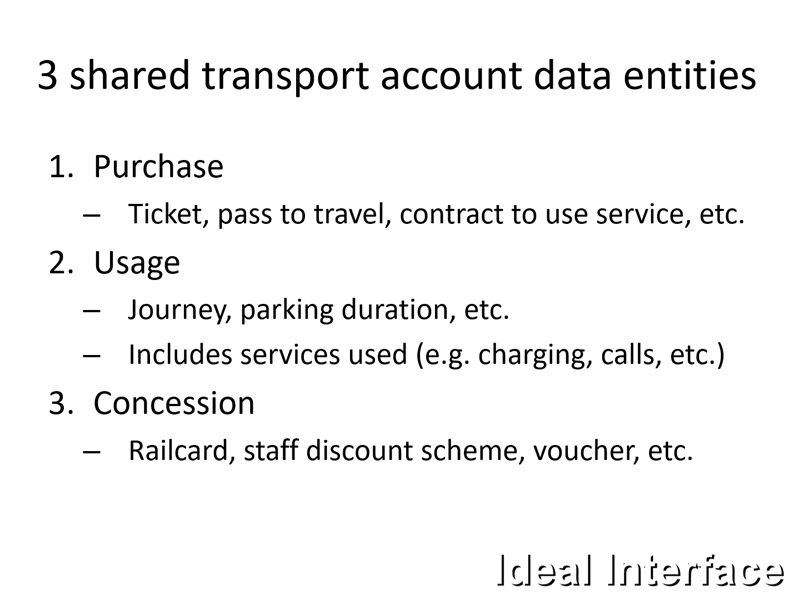
Our Open Transport standard for account data sharing therefore specifies 3 different “customer-account” data entities.

Note: None of the data entities we are proposing in our “customer-account” specification are personally identifiable information (PII).

These are:

Purchase
This can be a Ticket, pass to travel, contract to use a MaaS service, etc.

Usage
Journey, parking duration, etc. The specification also includes services consumed when this usage takes place e.g. electric vehicle (EV) charging, in-flight phone calls, etc.

Concession
This would be for something such as a Railcard or staff discount scheme. But could also include a pre-paid voucher / coupon, etc.

Peer review & feedback welcome:
All details of both draft API specifications (“customer-account” and “operator-info”) are publicly available to view online here:
https://app.swaggerhub.com/search?type=API&owner=open-transport

Open Transport requires a mindset change

The integration of different transport accounts owned by the same person (e.g. their rail, subway and electric scooter accounts) is certainly a technical challenge. But one that the Open Transport initiative believe can be overcome, especially if common standards such as open APIs are used.

But technology isn’t the only barrier to overcome. Complete transport account interoperability also needs transport providers to accept they are just part of the complete customer journey.

It also requires different industries such as public transport, transport technology & MaaS platform vendors and even airlines & car parking apps to integrate and work together for the benefit of the customer.  Leading to the swifter and easier implementation of an end-to-end Mobility-as-a-Service (MaaS ) transport ecosystem.

Helping to piece together end-to-end journeys

A person’s journey (e.g. making their regular commute to work) does not start and end when they board and get off a bus or train. For most travellers there is also additional travel taking place (e.g. when they leave the house to get to the stop or station and when they continie their onwards journey at the other end to get to their work place).

In some cases these additional pieces of travel are on foot. But in other cases these are made by taxi, ride share, electric scooter or even another bus or train.

In a fragmented transport environment this therefore makes it rather hard for the travelling customer to piece together their entire door-to-door journeys made using more than one mode of transportation. Typically needing them to log into and view multiple online accounts at the same time.

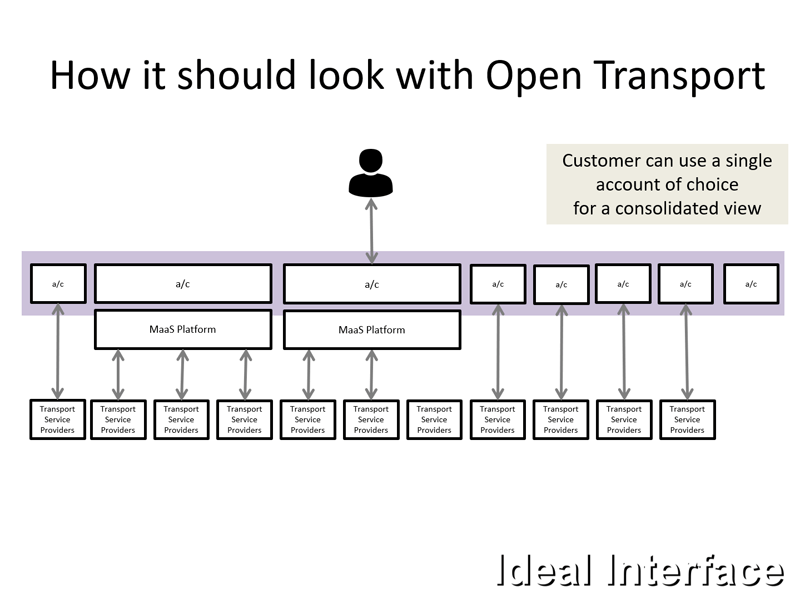
What we are therefore developing at Open Transport is a way to link these different transport provider accounts for the same individual. Once linked, they can then log into an account of their choosing and get a much better consolidated view of their end-to-end journeys (plus their tickets purchased and any discounts they are entitled to)

Deliverables & timescales to create an initial Open Standard

We have been asked what our timescales are around delivering an Open Standard, so we thought we would be completely transparent about our aims here.

Note: The current work to create both API specifications (‘customer-account’ and ‘operator-info’) are the intellectual property of Ideal Interface. This will change when version 1.0 of the Open Standard is created.

14th October 2019 (International Standards Day)
Draft ‘Customer-account’ API specification v0.9 issued for industry peer review

4th November
Draft ‘Operator-info’ look-up API specification v0.9.1 issued for industry peer review

20th December
Final date for feedback and questions

3 January 2020
Launch of v1.0 as Open Standard. This will also be be when there is the official handover of on-going management and further changes of specification & documentation from Ideal Interface to a new ‘Open Transport’ organisation.

Open Transport shortlisted for Global Ticketing Technology Award

We are incredibly proud to announce that Open Transport has made the 2020 Transport Ticketing Global Awards Shortlist. Our work, in creating the first open API specification for transport account interoperability, is in the category of Ticketing Technology of the Year.

The winners will be announced at the Transport Ticketing Gala Dinner & Awards ceremony on 28 January 2020. This will be held in the impressive “Making the Modern World” hall at the Science Museum.

This is further confirmation of how positively the industry is reacting to the work done so far by the Open Transport Initiative. 2020 promises to be a great year.

Peer review from MaaS Scotland community

Thursday 5th December saw Hayden Sutherland present the Open Transport work to a number of Maas Scotland members and other interested parties. This was part of an event called “Data: Fuelling the transport technology revolution”

The purpose of the Open Transport session in the afternoon was to get a wider peer of what has been produced by the initiative so far, with the aim of creating an Open Standard by early 2020

The first part of the session was to:

  1. Provide attendees with an overview what Open Transport provides
  2. Explain why we think this innovation is needed
  3. Go into more detail about what it is we have created (and is not)
  4. Describe the proposed high-level architecture
  5. Highlight the timescales for the next few weeks until the specifications become an Open Standard

Hayden then took part in an interactive workshop session (Q&A and more detailed discussion), where different MaaS Scotland members asked questions and contributed thoughts including:

  • Similarities to Open Banking and points of differentiation
  • Methods of validating users looking to join different transport accounts
  • How the Open Transport standard intersects or aligns with other standards
  • What the following steps would be & any barriers to achieving this

Overall the group was very supportive of the work done so far. They also acknowledged that this was a first step towards wider market acceptance and adoption of open standards and that more work was now required to develop both the centralised ‘operator-info’ API look-up directory service and create a reference implementation of an account using the ‘customer-account’ API integration specification.

Open Transport would therefore like to extend its huge thanks to MaaS Scotland for all its support so far.