Why isn’t transport & mobility piloting Smart Data sharing?

The UK transport & mobility sector is the largest emitter of CO2 and other greenhouse gases. Consumers and small businesses generate a wealth of useful personal transport and mobility data as they move about their lives or work. This includes information about products purchased (tickets), journeys undertaken (routes, durations, etc.) and discounts & concessions used (railcards, etc.).

Additionally, individuals and businesses are becoming increasingly aware of the emissions generated by their travels and are motivated to minimise these footprints.

Data is key to good decision-making for reaching NetZero. But currently, finding and accessing the data across different accounts is hard. Powerful barriers – technical, legal, commercial – prevent data from being shared, leaving it under-exploited and often hidden from view.

The UK Government has understood this and coined the term ‘Smart Data’ to refer to the secure sharing of customer data with named / authorised third-party providers upon the customer’s request. The concept started with Open Banking, but a wider adoption of Smart Data is now being implemented, with initiatives such as Open Finance, Open Energy, Open Telecoms being planned. The UK Government has also formed a Smart Data Council to extend the benefits of Smart Data to new sectors.

So why isn’t the transport and mobility in the UK being used as a pilot or an early adopter of Smart Data sharing practices?

Perhaps because the sector is highly deregulated and fragmented, with many regional providers across different transport modes? Therefore making it harder to start the process.

Or perhaps because transport isn’t currently politically or socially important as the the finance or utilities / energy sectors, which also have a high degree of competition and therefore regulation & governance.

How to future-proof your next customer transport system purchase

The Public Transport sector is not known for swiftly and easily taking on tech innovations. Adopting new technologies may be appealing to some (especially users), but so is running an efficient, safe and reliable passenger & freight service around a city, region or country.

Keeping up with customer demands in the transport industry is a continuous cycle… There’s new user experience trends, exciting (well to some) payment types and a constant flood of mobile apps & digital services to integrate with. Customer needs are now firmly set by the big technology companies, with everyone expecting “Apple-like functionality” all the time.

So if you are a transport service provider how can you ensure your next customer-facing application will be future-proof?

The short answer is “you can’t”. Predicting what the future will bring is almost impossible, and by the time most organisations have usually specified, procured and delivered something technical to be delivered it is almost certainly no longer going to be cutting edge.

However, transport authorities apply some key principles to ensure what they procure is as forward-compatible as possible…

  1. Use self-contained, modular & independent services that each meet specific use cases, rather than implement a huge application that you only need part of (and that quite possibly duplicates functionality you already have elsewhere)
  2. Have a clear “buy vs build” policy and understand the business & tech impact of each, including longer-term considerations such as: hosting, support & maintenance and future changes.
    Notes:
    Buy usually means purchasing a solution (“off the shelf” or as a “software-as-a-service” [SaaS] product) that another organisation has previously built, then enhancing it or configuring it to meet your own needs.
    Build usually means designing, developing and testing a bespoke solution with your own resources (either in-house or using a 3rd party)
  3. Use Open and Interoperable standards, to ensure your technology integrates & works with other technology and that it can easily be expanded & upgraded. Proprietary standards, specific to a single vendor, can trap you in a situation where you’re reliant on that vendor for future upgrades, maintenance, and support. This lack of choice can significantly inflate costs and limit your options in the long run. Open standards, on the other hand, allow you to choose from a wider pool of compatible vendors and products, fostering competition and potentially driving down costs.

Ecosystem – The key to a better transport & mobility industry

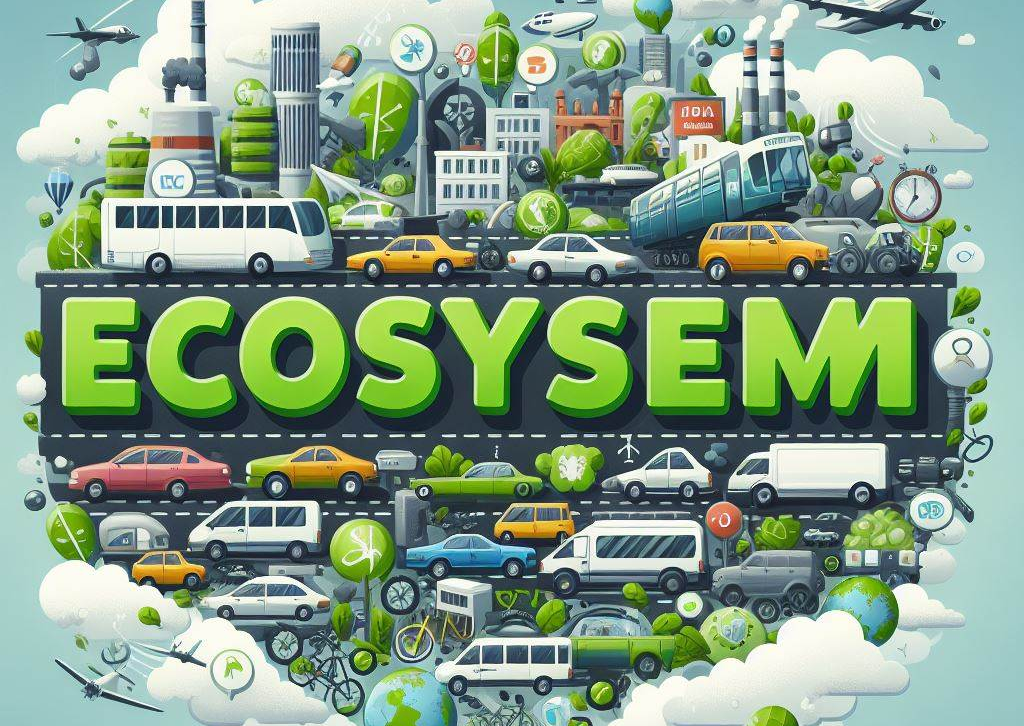
The word “Ecosystem” isn’t used as much as it should be in the transport and Mobility-as-a-Service (MaaS) sector. The term has far more usage in other sectors, such as financial services, where it is now more regularly used by most banks and FinTechs. And increasingly in the Open Finance world of insurers, credit companies, etc.

The term (sometimes also called a Digital Ecosystem) typically refers to a complex network of interconnected people, businesses, and technologies that interact with each other through digital platforms and data. It’s analogous to a natural ecosystem, where different components work together to create a functioning whole.

They are important for the following reasons:

1. Enhanced Collaboration and Efficiency:
By fostering seamless data exchange and communication between different entities, digital ecosystems enable efficient collaboration and streamlined workflows. Imagine a supply chain where manufacturers, distributors, and retailers are all connected on a digital platform, enabling real-time information sharing and synchronized operations.

2. Innovation and Value Creation:
Digital ecosystems create an environment where different players can share ideas, resources, and expertise, fostering innovation and the development of new products, services, and business models. This collaborative environment can lead to the creation of significant value for all participants within the ecosystem.

3. Improved Customer Experience:
By integrating various touchpoints and services, digital ecosystems can provide a unified and seamless customer experience. Imagine a travel ecosystem where you can book flights, hotels, and activities all within one platform, with each element seamlessly connected for a smooth and personalized journey.

4. Increased Market Reach and Opportunities:
Digital ecosystems can connect businesses to a wider audience and open up new market opportunities. For instance, an e-commerce platform like Amazon creates a digital ecosystem where small businesses can reach a global customer base they wouldn’t have access to otherwise.

5. Adaptability and Future-Proofing:
By being open and interconnected, digital ecosystems can adapt and evolve more readily to changing market demands and technological advancements. This flexibility allows businesses to stay competitive and relevant in a dynamic environment.

So perhaps it is time transport providers, mobility start-ups and others used the term more often and thought of the entire transport & mobility sector as a single large ecosystem (rather than as different modes, transport authorities & regions, etc.).

What is Smart Data and how does it help us meet Net Zero goals?

In the UK the transport & mobility sector is now the largest emitter of CO2 and other greenhouse gases (GHGs). Helpfully though, individuals and businesses are becoming increasingly aware of the emissions generated by their travels and are motivated to minimise these footprints to help reach the Net Zero target by 2050 – the date set in The Paris Agreement when all greenhouse gas emissions will be equal to the emissions removed from the atmosphere.
https://unfccc.int/process-and-meetings/the-paris-agreement/the-paris-agreement

Data is key to good decision-making for reaching NetZero. But currently, finding and accessing the data is hard. Consumers and businesses generate a wealth of useful personal transport and mobility data as they move about their lives or work. This includes information about products purchased (tickets acquired), journeys undertaken (routes taken, journey durations, travel dates/times), and travel cost management practices (discounts and off-peak travel strategies). But powerful barriers – technical, legal, commercial – prevent this customer account data from being shared, leaving it under-exploited and often hidden from view. 

The UK Government has understood this and coined the term ‘Smart Data’ to refer to the secure sharing of account data with named / authorised third-party providers, upon the customer’s request. The concept started with Open Banking, but a wider adoption of Smart Data is now being implemented, with initiatives such as Open Finance, Open Energy and even Open Telecoms being planned. The UK Government has also formed a Smart Data Council to extend the benefits of Smart Data to new sectors.

The Open Transport Initiative therefore wants to see Smart Data being adopted and implemented for account data sharing across the transport & mobility sector too. With the aim of helping individuals and businesses to further reduce their impact on the planet and transition to a more sustainable future.

Why transport & mobility needs Smart Data

The transport and mobility sector in the UK (and other countries) is highly deregulated and fragmented, with services from many regional providers across different modes of transport. There are 20+  train operating companies, dozens of bus and tram operators, numerous taxi and micro-mobility companies, and more recently many new Mobility-as-a-Service [MaaS] platforms being launched. Each service has their own customer account, with a huge amount of siloed transport data, all stored in disparate systems in a range of ways.

To make things worse… The GDPR individual Right to Data Portability is rarely kept to across the sector. Meaning there is often no way for each user to export their account data in any meaningful way (let alone import data from one account into another).

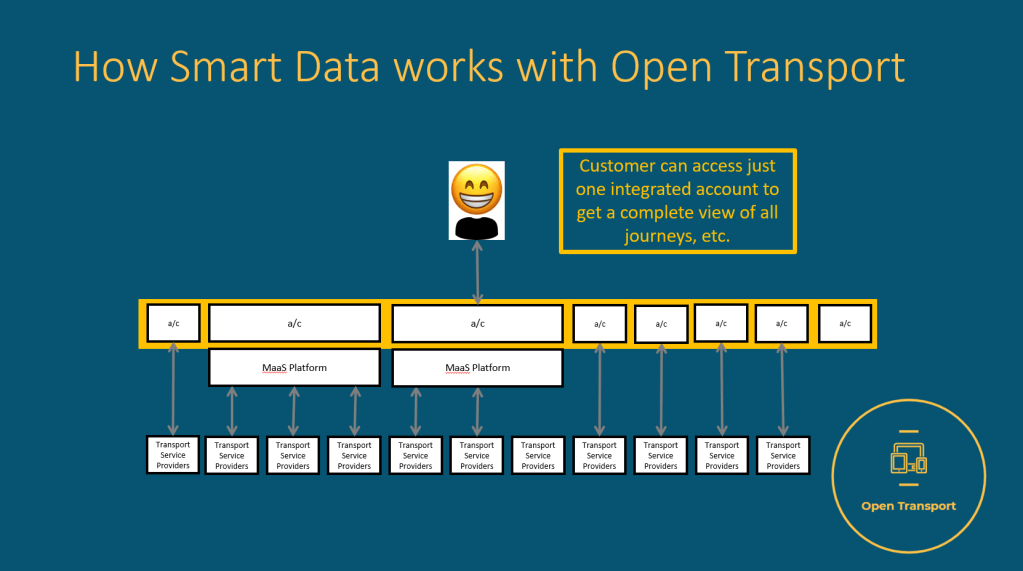
By securely linking different mobility accounts all managed by the same user, it will be possible to share data between them and with a trusted Third-Party Processor [TPP] in a standardised way. This then allows the aggregated and consistent presentation of multi-modal information to the user in a single “Transport Dashboard”. This application can then show the user additional useful information, such as:

  • cheaper fares
  • shorter travel times / routes
  • alternative modes of transport
  • combined amounts of CO2 and other Greenhouse Gases (GHGs)

Presenting the joined-up data in this way helps the user understand the impact and costs of their travel, and can then be used to change future behaviour – such as choosing less polluting modes and providers.

Multi-sector Smart Data is the key to maximising its value

The Open Transport Initiative was originally set-up to create and support the adoption of customer account data sharing (AKA “Smart Data”) across the transport & mobility sector. And having data (such as usage, journey information & discounts) shared from different accounts across the sector is an important first step. However the maximum benefit of Smart Data lies in the potential to connect cross-sector data.

The diagram below is our attempt to show how data from different sectors can be shared with transport data to create new and exciting cross-sector services.
For example, combining vehicle (e.g. car, motorcycle, etc.) usage data with financial product information could create a completely personalised insurance suite of products.

How can data help transport & mobility move to Net Zero?

Greenhouse gas (GHG) emissions from the transport and mobility sector are increasing, despite global agreements to reach net zero emissions by 2050. In 2022, global CO2 emissions from transport grew by more than 250 Megatonnes, reaching 8 Gigatonnes in total. https://www.iea.org/energy-system/transport

The sector therefore has the responsibility to decarbonise, quickly.
(And like all good transport analogies, this transition needs a roadmap.).

Unfortunately, the transport and mobility sector’s roadmap to reach net zero emissions by 2050 isn’t an easy one. It will involve a major transformation of the way move people and goods. It will require a shift to cleaner fuels, more efficient vehicles, and a greater focus on public transportation and other sustainable modes of transport.

But this cannot happen without data (or put more frankly… no data, no decarbonisation).
Data can play a critical role in the transition to net zero transport in a number of ways, including:

  • Operations: Using data to optimize transport providers’ routes and therefore reducing fuel consumption. For example, planning delivery routes in a way that minimizes the distance travelled.
  • Operations: Using data to develop new technologies for decarbonizing the transport sector. For example, to develop new battery chemistries that could make electric vehicles more affordable and efficient.
  • Change user behaviour: Using data to developing policies that discourage the use of high CO2 emitting modes of transport.
  • Change user behaviour: Using data to incentivise the use of low-carbon transport options.

Sharing data can further help with the transition to Net Zero for the sector by both:

  1. Making it easier for different authorities to collect, analyse, and share (anonymised user) data
  2. Allowing users to securely share the multiple sources of information that they have in their individual transport accounts, to help them plan and use less co2

If you would like to join or know more about the work of the Open Transport Initiative please contact us: 
contact@opentransport.co.uk

The Open Standard for Transport & Mobility sector GDPR Compliance

The General Data Protection Regulation (GDPR) is a regulation in the European Union (EU) that outlines the rights of individuals with regards to their personal data. The UK’s implementation of the GDPR is the Data Protection Act 2018 (DPA 2018). The DPA 2018 is very similar to the GDPR and sets out the same rights for individuals and obligations for organizations.

One of the rights that the GDPR provides is the right to data portability. This right allows individuals to request that the data controller (the entity that collects and processes their personal data) provides them with a copy of their personal data in a structured, commonly used, and machine-readable format. Individuals can also request that the data controller transmit their personal data directly to another data controller, if technically feasible.

In fact, Data controllers are encouraged by the legislation to develop interoperable formats that enable data portability.

For the transport sector, this means that a customer has the right to move, copy or transfer personal data easily out of an account for one provider mobility and into another … in safe and secure way, without affecting its usability and ‘without hindrance’.

Our Open Standard API specification for exchanging data between different transport & mobility accounts uses JSON – a structured, commonly-used and machine readable format.
It therefore enables interoperability between each system, but without them all having to maintain compatibility with each other.

If you are a Data Controller or transport & mobility technology supplier and would like to know more, please contact us: contact@opentransport.co.uk

Shared and Sovereign Transport & Mobility can use the same data sharing standards.

Our work has led us to creating the Open Standard for customer account data sharing across the transport & mobility sector. This allows any transport account to be able to securely share specific data (e.g. mobility products, journeys and travel discounts) with named & agreed third parties. It is similar in principle to other data sharing initiatives such as Open Banking and Open Finance, an overall technology named ‘Smart Data’ by the UK Government.

Decentralized or Sovereign data is a different approach, in that personal data does not reside in a number of different user accounts across an ecosystem. Instead, this data sits in a Sovereign account controlled / managed by the customer and the user grants each party access to just the data they require.

Our approach enables a consolidated view of transport & mobility account data from different participating providers (either in one or more accounts, including third party ones). Whereas the decentralised approach uses an additional account, typically called a Mobility Data Space, to manage all the user’s transport data in a single location (with the transport providers potentially seeing far less data about the individual).

But….

Both are ways of sharing mobility data.

Both help the user to be in control of their own data and allow it to be viewed and used for better mobility outcomes – e.g. to plan and travel in faster, easier and greener ways.

Both rely on the exchange of non-personal transport data, such as: tickets purchased, usage made via each specific mode or vehicle and even the concessions the individual is allowed to use.

So why don’t they both use the same standard for the sharing of this same data?

Or put another way… why create a very similar customer mobility data sharing standard for Decentralized or Sovereign transport data when one already exists for shared / Smart transport data?

We would welcome the opportunity to work with any other organisation working on any sort of decentralized transport & mobility initiative.
contact@opentransport.co.uk

Smart Data for Open Transport?

For the last few years, departments within the UK Government have been using the term ‘Smart Data’ to refer to the secure sharing of customer data with named / authorised third-party providers (TPPs), upon the customer’s request.

The concept started with Open Banking, but a wider adoption of Smart Data is now being implemented, starting with Open Finance and then the Open Energy, Open Telecoms / Open Telco and (hopefully) into Open Transport.

And recently the Smart Data Council has been set-up (taking forward the work of the Smart Data Working Group), with the aim of making it easier for more consumers and small businesses to switch providers of some utilities, therefore supporting families to save money.

Smart Data has its own place in the Data Spectrum, and in our version specifically for the Transport & Mobility sector, the types of data expected to be shared are:

  • Transactions & tickets (e.g. products purchased or entitlements to travel)
  • Journeys made
  • Concessions or discounts

These are the data entities described in our Open Transport Customer-account API Specification: https://opentransport.co.uk/open-standard/