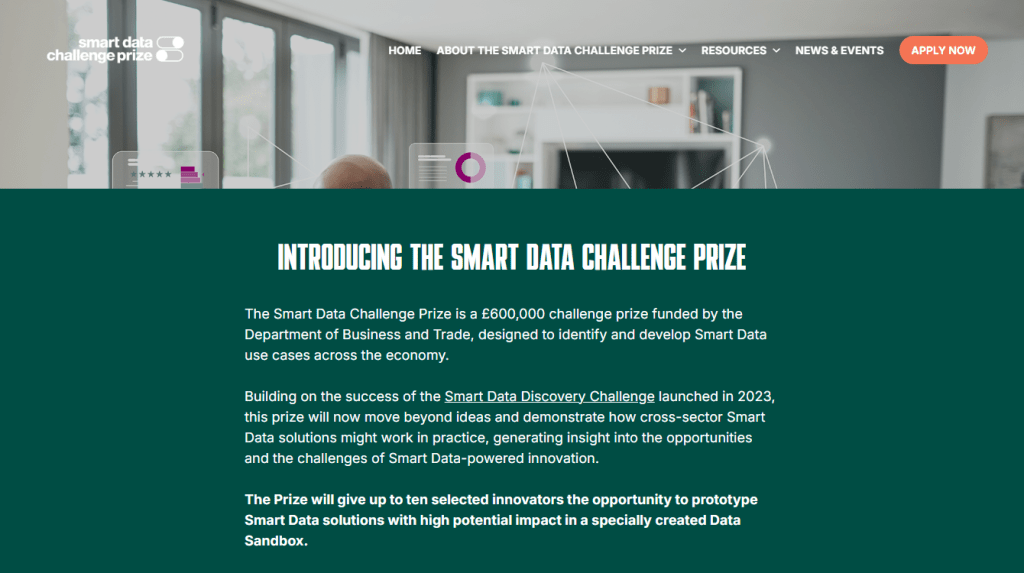
This week sees the announcement of the Smart Data Challenge Prize. This is a £600,000 pot funded by the Department of Business and Trade, designed to identify and develop Smart Data use cases across the economy. “The Prize will give up to ten selected innovators the opportunity to prototype Smart Data solutions with high potential impact in a specially created Data Sandbox.”
The Open Transport welcomes the launch Smart Data Challenge Prize and is also strongly considering submitting an application. We are therefore very keen to work with and potentially jointly applying for this challenge with other organisations across the transport & mobility sector.
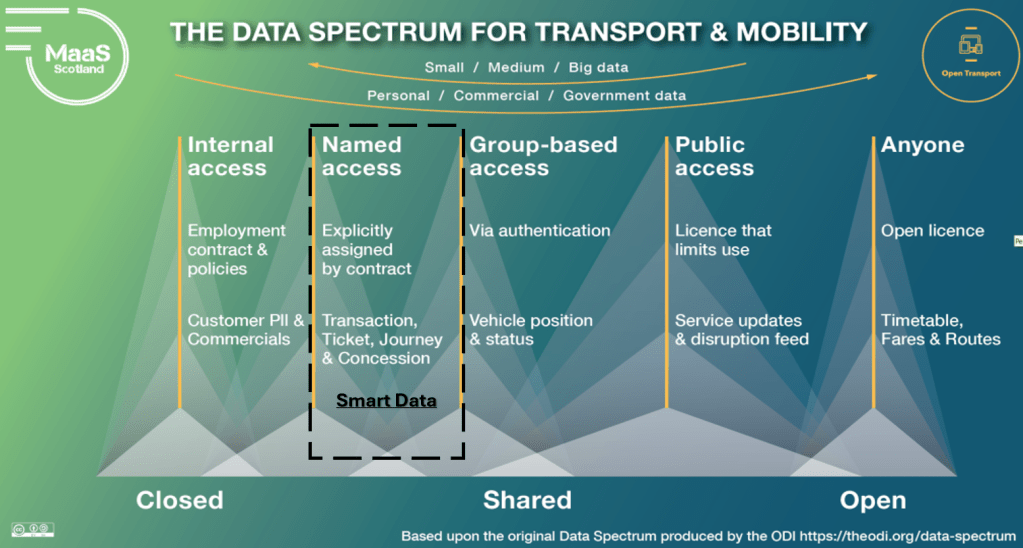
Several years back we worked with MaaS Scotland (the umbrella organisation for Mobility-as-a-Service [MaaS] activities in Scotland) on the creation of The Data Spectrum for Transport & Mobility.
This diagram was a small (but significant) step forward in the data maturity of the sector. In that it adopted the original work of The Open Data Institute and aligned transport & mobility to data terminology already used by other sectors such as banking, energy, and smart cities. https://opentransport.co.uk/2021/06/23/launching-the-data-spectrum-for-transport-mobility/
More recently, and with the more common use of the term Smart Data to the secure sharing of customer data with Authorised Third Parties [ATPs], we have been asked where this sort of data (e.g. transactions, journey history and discounts & concessions) sits within the Data Spectrum.
Luckily, its position is easy to spot… as it is a particular sort of data that is shared securely with authorised (named) parties with the customer’s permission (a data sharing contract). And consequently can be thought of as ‘Named Access’ data that sits in the area outlined below.
If you would like to join or know more about the work of the Open Transport Initiative please contact us: contact@opentransport.co.uk
In October this year several organisations were invited to a Smart Transport Data Roundtable in Leeds organised by Intelligent Transport Systems UK (ITS UK), the industry body for transport technology, and the Open Data Institute (ODI).
At this Roundtable the role of smart data in a transport context was discussed, learnings from other industries where smart data has progressed were shared and participants discussed what a smart data approach could mean for transport providers and suppliers, the Mobility-as-a-Service (MaaS) sector and the wider transport network.
At the end of the meeting it was agreed by the attendees that a regular meeting should be held, to continue the momentum from the day and move the topic forward. This then led to the first “Smart Data 4 Transport” group meeting that happened this week.
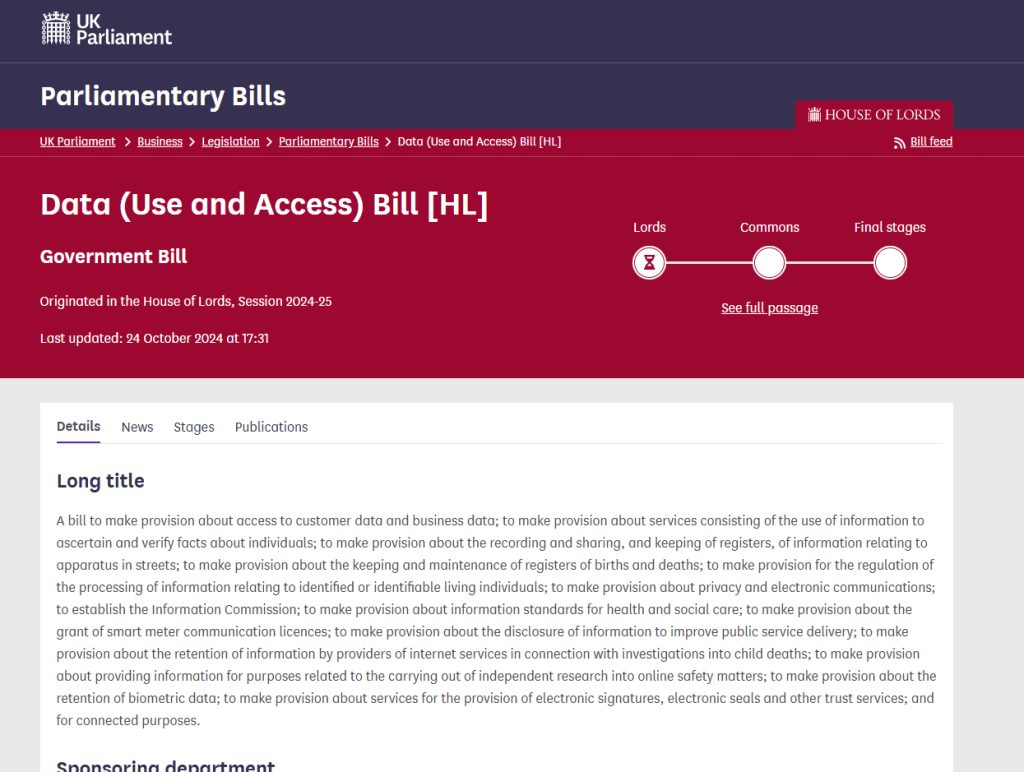
A newly renamed Data Use and Access Bill was been introduced to Parliament on Wednesday 23rd October 2024. This creates the conditions for the future success of Open Banking and the growth of other Smart Data schemes.
Disappointingly, there was no specific mention of the Transport & Mobility sector in the announcement.
But the wording of the Bill is encouraging:
“The Bill, delivered by the Department for Science, Innovation, and Technology, has three core objectives: growing the economy, improving UK public services, and making people’s lives easier. The measures will be underpinned by a revamped Information Commissioner’s Office, the UK’s independent authority responsible for regulating data protection and privacy laws, with a new structure and powers of enforcement – ensuring people’s personal data will be protected to high standards.”
The following is a post originally published on our company LinkedIn page, but now copied here for reference:
Smart Data? For those that are not familiar with this term, Smart Data is the secure sharing of customer data with authorised third parties (ATPs). The most popular example of Smart Data is Open Banking, introduced via legislation in January 2018. Back then it forced the UK’s nine biggest banks (HSBC, Barclays, RBS, Santander, Bank of Ireland, Allied Irish Bank, Danske, Lloyds and Nationwide) to allow data they held online to be shared with authorised organisations in a secure, standardised form. Open Banking has then fuelled the FinTech sector, one of the UK’s economic success stories of the last decade. Note: Other terms such as “Open X”, “Open Economy” and “Open Everything” have also been used, to various degrees, in the past. But the UK Government has chosen and used the term “Smart Data” for the last few years… so those who work in and around the topic of data sharing have also adopted and embraced it.
This paper clearly stated that : “the government wants to see similar and interoperable schemes in sectors beyond retail banking to realise a world-leading Smart Data economy”
What is a Smart Data economy? With the success of Open Banking, the aim of UK Government is now to ‘open up’ customer data sharing across different sectors of UK industry such as: energy, finance, home buying, retail, telecommunications and transport. This will, as a result:
empower consumers and small business customers – putting them in control of their own data
turbo charge competition, innovation and growth – removing data ‘lock-in’ created by anti-competitive practices
unlock the potential for smart data to drive the wider data economy
Note: The origins of the Smart Data economy are actually based upon the UK Government Data Strategy (2017 updated 2023) that set out how to unlock the power of data in the UK economy: “To support industry in unlocking value from data, we will work with organisations such as the Open Data Institute to create an environment to open up customers’ data across more sectors through the use of APIs (Application Programming Interfaces). This will help the development of innovative new applications, such as dashboards that bring together household bills, or tools that could automatically switch consumers to the cheapest energy deal based on their preferences and actual usage. The UK is the first country to start work on developing an Open Banking API that uses data to provide helpful information to consumers when using banking services.” https://www.gov.uk/government/publications/uk-digital-strategy/7-data-unlocking-the-power-of-data-in-the-uk-economy-and-improving-public-confidence-in-its-use
Will a Smart Data Economy bring economic benefit? Yes, the UK Gov Digital Strategy has stated that building a Smart Data economy could unlock £149 billion of organisational efficiency and £66 billion of new business and innovation opportunities in the UK economy. Meaning the Smart Data economy is potentially worth a total of £215 billion over five years… if implemented properly and completely.
How can we build a Smart Data Economy? Creating the world’s first Smart Data economy will not be plain sailing. There are a number of steps necessary to build and maintain it, including the introduction of legislation to create statutory powers to introduce separate Smart Data schemes. But just this week, in the Kings Speech (17 July 2024) the new UK Government confirmed the introduction of a Digital Information and Smart Data Bill. Which includes setting up Smart Data schemes in different sectors. https://assets.publishing.service.gov.uk/media/6697ac9cab418ab05559271d/King_s_Speech_2024_background_briefing_GOV.uk.pdf
Don’t forget the Transport & Mobility sector The Smart Data Roadmap, has 4 different maturity phases for the complete introduction of sector-specific schemes: 1. identification 2. consultation 3. design 4. implementation
The success of Open Banking has also understandably led to a focus on related areas. But the full benefits of a Smart Data Economy cannot be realised without including other important sectors, these (along with their Roadmap maturity) are:
Finance (Identification)
Energy & Road Fuels (Identification and Consultation)
The next steps in the Smart Data roadmap for Transport now sit with UK Department for Transport [DfT] to progress.
These steps include:
Taking forward discovery work to develop transport use cases for Smart Data.
Using the outcomes of the discovery to shape the evidence for a Call for Evidence in Autumn 2024, along with potential questions.
Publishing further detail on the opportunities for Smart Data in the transport sector in 2025.
Who is working to implement Smart Data in our sector? The Open Transport Initiative has been working towards the introduction and establishment of Smart Data sharing in Transport & Mobility for several years. The organisation was specifically set-up in 2019 to drive forward the adoption of “Open Banking” data sharing practices across the sector. Their aim has been to engage with providers, authorities and government to support the uniform & standardised implementation of such a Smart Data scheme. https://opentransport.co.uk/
This work even includes the creation & publication of Open Standard (free to use) APIs, which should help vendors and developers to deliver the technical changes needed. https://opentransport.co.uk/open-standard/
If you would like to join or know more about the work of the Open Transport initiative content them via: contact@opentransport.co.uk
A Smart Data Economy is the roll-out of Open Banking-like data sharing across sectors, including: energy, finance, home buying, retail, telecommunications and transport.
The UK Gov Digital Strategy has stated that building a Smart Data economy could unlock £149 billion of organisational efficiency and £66 billion of new business and innovation opportunities in the UK economy.
empower consumers and small business customers – putting them in control of their own data
turbo charge competition, innovation and growth – removing data ‘lock-in’ created by anti-competitive practices
unlock the potential for smart data to drive the wider data economy
The origins of the Smart Data economy are actually based upon the UK Government Data Strategy (2017 updated 2023) that set out how to unlock the power of data in the UK economy:
“To support industry in unlocking value from data, we will work with organisations such as the Open Data Institute to create an environment to open up customers’ data across more sectors through the use of APIs (Application Programming Interfaces). This will help the development of innovative new applications, such as dashboards that bring together household bills, or tools that could automatically switch consumers to the cheapest energy deal based on their preferences and actual usage. The UK is the first country to start work on developing an Open Banking API that uses data to provide helpful information to consumers when using banking services.”
The King’s Speech today covered the introduction of the Digital Information and Smart Data Bill.
This includes: “setting up Smart Data schemes, which are the secure sharing of a customer’s data upon their request, with authorised third-party providers”.
A report titled “Manifesto for the Future of Transport” has been published today by Intelligent Transport Systems UK [ITS], the voice of the transport technology industry. Purposefully released ahead of the UK General Election in 4 weeks, this paper focuses on Mobility-as-s-Service [MaaS] and Data, including Smart Data sharing across the sector.
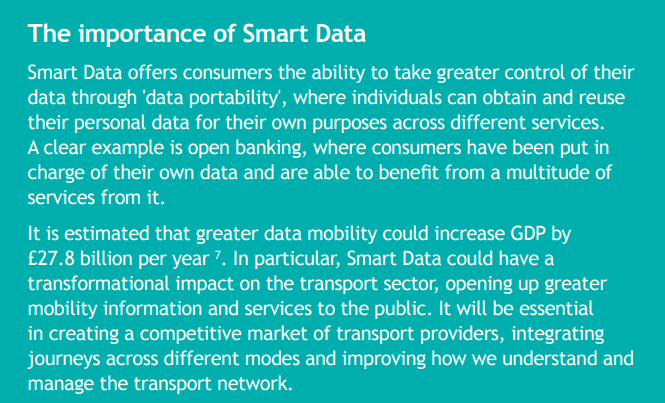
“Smart Data offers consumers the ability to take greater control of their data through ‘data portability’, where individuals can obtain and reuse their personal data for their own purposes across different services. A clear example is open banking, where consumers have been put in charge of their own data and are able to benefit from a multitude of services from it.” “It is estimated that greater data mobility could increase GDP by £27.8 billion per year 7. In particular, Smart Data could have a transformational impact on the transport sector, opening up greater mobility information and services to the public. It will be essential in creating a competitive market of transport providers, integrating journeys across different modes and improving how we understand and manage the transport network.”
The recent Smart Data Roadmap published by the UK Government’s Department for Business & Trade was a pleasant surprise for the Transport & Mobility sector, as it specifically mentions transport (alongside energy, telecommunications, retail, etc.). It even lists a number of actions to be carried out by the Department for Transport [DfT] over the next year, including:
Taking forward discovery work to develop transport use cases for Smart Data.
Using the outcomes of the discovery to shape the evidence for a Call for Evidence in Autumn 2024, along with potential questions.
Publishing further detail on the opportunities for Smart Data in the transport sector in 2025.
These activities are expected to highlight the range of purposes that Smart Data can be used for across the sector and hopefully allow it to make swift progress through the different stages of Smart Data maturity… from “Identification” to “Consultation”, then “Design” and then eventually “Implementation” of something like an Open Banking for Transport & Mobility scheme.
The need for Smart Data Pilots
The Smart Data Roadmap also contained some examples of the opportunities for Smart Data in Transport. Naming: The Bee Network in Greater Manchester (that uses Bus Open Data Service information for real-time feeds) and the Future Transport Zones [FTZ] (large scale DfT sponsored Mobility-as-a-Service [MaaS] schemes being set-up & run in different areas of England).
However, it is important to note that none of the initiatives mentioned currently provides any form of Smart Data account sharing functionality to their customers. And perhaps more importantly… that no MaaS scheme being run anywhere in the UK has yet to fully comply with the GDPR individual right to data portability.
There are many benefits for the adoption of Smart Data in transport & mobility sector. It is therefore important to mobilise pilot Smart Data schemes across the UK, to understand the intricacies of implementing and running them at any scale.





 Open Transport - Transport & Mobility Data Interoperability