Open Transport APIs update – July 2025

This week we have been busy migrating our Open APIs to a different account. This means that the URLs have changed, some contact information has changed and therefore we have incremented both versions for complete traceability and transparency:

Old versions

Operator API
https://app.swaggerhub.com/apis/open-transport/operator-info/1.1.0

Customer API
https://app.swaggerhub.com/apis/open-transport/customer-account/1.0.2

New versions

Operator API
https://app.swaggerhub.com/apis/opentransport/operator-info/1.1.1

Customer API
https://app.swaggerhub.com/apis/opentransport/customer-account/1.0.3/

Notes:

  1. There are no other changes (breaking or otherwise) created as a consequence of this change
  2. We have also changed the URLs on our API web page to reference the new versions: https://opentransport.co.uk/open-standard/

We will also soon be closing down the old account and the new ones will be the only versions available.

As always…

Amendment process:
If anyone would like to consider any additions or changes to these, please see our published amendment process:
https://opentransport.co.uk/2020/02/03/amendment-process-for-our-open-standards/

Usage policy:
Both API specifications are published as Open Standards using the Apache 2.0 license. This means our work is free for anyone to use, copy and even change (as long as an accompanying Apache 2.0 license is used, the work of The Open Transport is clearly attributed and any modifications are explained)

Open Transport is Smart Data Challenge Finalist

The Smart Data Challenge Prize was announced in January 2025 and has sought to find teams that can:

Identify Smart Data use cases that utilise multiple datasets from sectors across the economy, and build prototypes, demonstrating their market feasibility and potential to deliver real-world benefits for consumers and businesses (pending implementation of Smart Data schemes).
Smart Data Challenge website

Open Transport has been announced as one of ten finalists, each receiving £50,000 in grant funding to utilise multiple datasets from sectors across the economy, and build prototypes, demonstrating their market feasibility and potential to deliver real-world benefits for consumers and businesses.

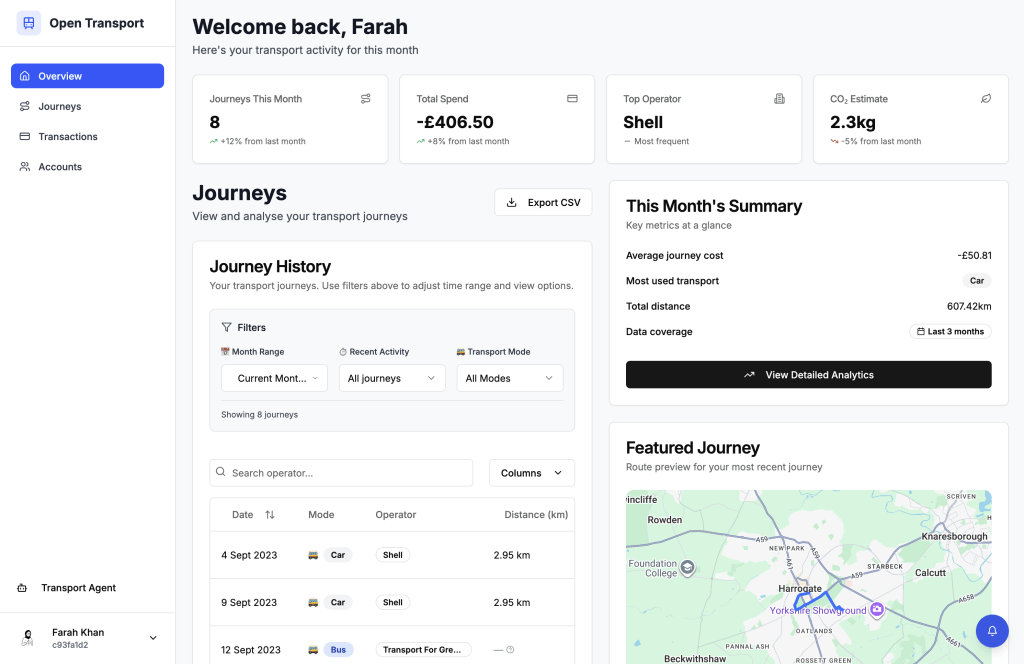
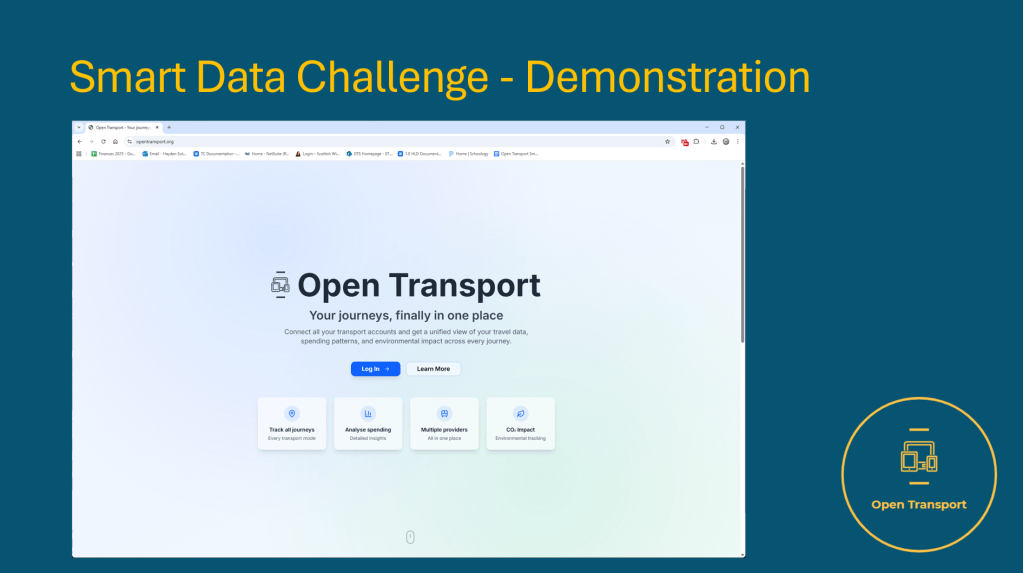
Our own proposal seeks to use multiple sources of transport and journey data, consumer financial data and open data around CO2 emissions of transport modes to create the first working personalised transport data dashboard for customers, to make informed, efficient travel decisions while minimising environmental impact.

You can read more about it here.

Smart Data 4 Transport Meeting – 1 April 2025

Context:

The Smart Data 4 Transport meeting held on April 1, 2025, brought together key stakeholders from various sectors, including transport, data governance, and procurement. The discussion focused on the implementation and implications of Smart Data initiatives in the transport sector, particularly in relation to the ongoing Data Use and Access Bill and the Smart Data Challenge. Participants included representatives from public & private sector, and the Open Transport Initiative Advisory Board.

Agenda:

The meeting covered several main topics, including:

  • Introductions of participants and their roles.
  • Overview of smart data and its distinction from open data and smart ticketing.
  • Updates on the Data Use and Access Bill and its implications for the transport sector.
  • Discussion of the Smart Data Challenge and the submission made by the Open Transport Initiative.
  • Future plans for the Smart Data Forum and governance models for smart data schemes.

Key Figures:

  • 27.8 billion: Estimated GDP value across UK from Smart Data
  • £600,000: Total prize pool for the Smart Data Challenge.
  • £50,000: Individual prize amounts available through the Department of Business and Trade for demonstrating cross-sector Smart Data use cases.

Topics discussed:

  1. Understanding Smart Data:
    Hayden Sutherland provided a definition of Smart Data, emphasizing that it involves secure sharing of customer data with their permission, contrasting it with Open Data, which is freely available under open licenses. Smart data is not to be confused with smart ticketing, which involves payment methods for transport.
  2. Data Use and Access Bill:
    The Data Use and Access Bill is currently in its report stage and aims to extend the principles of Open Banking to other sectors, including transport. The bill will enable the establishment of smart data schemes across various industries, requiring secondary legislation for specific implementations.
    https://bills.parliament.uk/bills/3825
  3. Smart Data Challenge:
    • The Smart Data Challenge, which ran from January 15 to March 14, 2025, aimed to identify and develop smart data use cases. The finalists will be announced in May.
    • Open Transport Initiative’s submission was discussed, which focuses on integrating Smart Data with Open Banking data to demonstrate interoperability and customer data sharing, linked with CO2 data.
      https://smartdata.challenges.org/
  4. Governance Models for Smart Data:
    The meeting touched on the need for effective governance models for smart data schemes and recent cross-sector interviews being conducted.
  5. Challenges Identified:
    • The fragmented nature of the transport sector, where multiple payment methods and data sources exist, complicates the integration of smart data.
    • The need to ensure that the system accommodates various user demographics, including those who rely on cash transactions or have limited access to banking or transports & mobility accounts (e.g. younger or older people)
  6. Future Implications:
    The discussion highlighted the importance of anticipating future regulatory changes and designing systems that are compliant with GDPR and other data protection regulations.

In conclusion, the meeting underscored the potential of Smart Data to transform the transport sector by enabling secure, user-centric data sharing and fostering innovation through reducing barriers to entry. The upcoming Smart Data Forum and continued engagement with stakeholders will be crucial in advancing these initiatives, but participants agreed that the introduction of such a scheme would be a long-term initiative.

Why is the Transport sector way behind on Smart Data?

The Smart Data roadmap (published 11 months ago by the previous UK Government) outlined the “Next steps to creating a Smart Data economy in the UK in banking, energy, finance, home buying, retail, telecommunications and transport“. It also identified the transport sector at the earliest stage of Smart Data Scheme Development: Identification

So currently the travelling customer lacks a unified way to accurately consolidate, view and use their transport data across multiple, or even single, modes of transport. Nor can they integrate granular travel data into existing Smart Data services, such as Open Banking.

This lack of integration and interoperability results in insufficient information at all levels, hindering the customer’s decision making, limiting their travel choices (which could be cheaper, faster, more qualitative or greener transportation) and minimising the potential for journey personalisation.

Why?

Well the fragmented, nebulous* and often deregulated nature of the transport sector makes it one of the most complex to implement. Also, the monopolistic practices of some large transport technology providers are helping to lock-in their customers, assisted by their use of bespoke integrations and proprietary standards.

The Open Transport Initiative was specially set-up to create and support the adoption of customer account data sharing (AKA “Smart Data”) across the transport & mobility sector. We believe that the implementation of shared & interoperable account data across all providers and modes will enables individual consumers and small businesses to access and share their data simply and securely with trusted, authorised third parties [ATPs] who can offer innovative services to them.

* what modes of transportation are actually transport or mobility?
Walking, car parking, cable cars?
Hint: Yes to all the above!

Smart Data 4 Transport – February meeting

Today was a further meeting of the “Smart Data 4 Transport” group, which launched back in December 2024.

The topics of the group this month were:

If you would like to be included in future meetings. please let us know:
contact@opentransport.co.uk

Integrating Transport Customer Data

Today, our Founder Hayden Sutherland, presented the latest developments in Smart Data for the Transport & Mobility sector during a webinar titled “Enhancing transport integration through data-driven analysis”.

This webinar, supported by SYSTRA and delivered by Landor LINKS Live!, explored the contribution of smart data, national pricing and integrating transport and non-transport policy in delivering an integrated transport network.
https://www.transportxtra.com/tx-events/2760/enhancing-transport-integration-through-data-driven-analysis/

The presentation Hayden title “Integrating Transport Customer Data” explained that Transport has made accessing data difficult and that it is becoming more complex.

  • Data is stored in many different systems, formats and technologies
  • There are hundreds of different online accounts across the sector (Bus, Rail, Taxi, Micro-Mobility, Air, MaaS, etc.)
  • The customer must work hard to access all their transport & mobility data
  • The customer needs to log into every account just to view their own transport tickets and usage data
  • GDPR rights of the individual are ignored

If you would like to know more Contact: hayden@opentransport.co.uk

What next for Transport & Smart Data?

The Transport Sector has made customer account data sharing difficult. There are now hundreds of different online accounts across the sector (Bus, Rail, Taxi, Micro-Mobility, Air, etc.), meaning each customer must work hard to access all their own transport & mobility data.
As an example, just to consolidate their transport expenses, customers need to log in to multiple accounts to view and export their transport tickets and usage information.
Plus, GDPR individual rights are ignored, such as The Right to Data Portability, which allows users the ability to “move, copy or transfer personal data easily from one IT environment to another in a safe and secure way, without affecting its usability”:
https://ico.org.uk/for-organisations/uk-gdpr-guidance-and-resources/individual-rights/individual-rights/right-to-data-portability/

This difficulty is perpetuated by:

  • The need for transport operators (and their technology suppliers) to keep data sources under their control, with each still wanting to ‘own’ their relationship with their customers.
  • A general lack of awareness of Smart Data and its potential benefits across the transport sector (e.g. no specific mention of Smart Data in the current DfT Transport Data Strategy “Innovation through data”
    https://www.gov.uk/government/publications/transport-data-strategy-innovation-through-data )
  • The lack of available customer account data sharing examples (pilots or full implementations).

To therefore drive the adoptions of Smart Data sharing across the wider transport sector the following is recommended:

  • Transport sector stakeholders must provide strategic guidance and sponsorship of customer account data pilots and projects – for example the recently announced Smart Data Challenge https://smartdata.challenges.org/
  • Transport data subject matter experts need to fully understand the role of Smart Data and its potential benefits across the sector – for example that it is still possible for transport operators to ‘own’ their relationship with their customers whilst still allowing them to share their account data with Authorised Third Parties [ATPs)]
  • Technologists need to familiarise themselves with the existing Open Standards for transport & mobility-specific data sharing and also contribute to their ongoing development and sector suitability: https://opentransport.co.uk/open-standard/
  • Customer account interoperability for any new Public Sector transport service or platform, for any mode, must be mandated (e.g. to ensure full compliance with GDPR) and then designed into all solutions from the onset, thus kick-starting the market and acting as implementation exemplars for the private sector to follow.

UK Government launches Smart Data Challenge Prize

This week sees the announcement of the Smart Data Challenge Prize. This is a £600,000 pot funded by the Department of Business and Trade, designed to identify and develop Smart Data use cases across the economy.
“The Prize will give up to ten selected innovators the opportunity to prototype Smart Data solutions with high potential impact in a specially created Data Sandbox.”

The Open Transport welcomes the launch Smart Data Challenge Prize and is also strongly considering submitting an application. We are therefore very keen to work with and potentially jointly applying for this challenge with other organisations across the transport & mobility sector.

If you would like to be involved, please contact us: contact@opentransport.co.uk

Where does Smart Data sit on the Data Spectrum?

Several years back we worked with MaaS Scotland (the umbrella organisation for Mobility-as-a-Service [MaaS] activities in Scotland) on the creation of The Data Spectrum for Transport & Mobility.

This diagram was a small (but significant) step forward in the data maturity of the sector. In that it adopted the original work of The Open Data Institute and aligned transport & mobility to data terminology already used by other sectors such as banking, energy, and smart cities.
https://opentransport.co.uk/2021/06/23/launching-the-data-spectrum-for-transport-mobility/

More recently, and with the more common use of the term Smart Data to the secure sharing of customer data with Authorised Third Parties [ATPs], we have been asked where this sort of data (e.g. transactions, journey history and discounts & concessions) sits within the Data Spectrum.

Luckily, its position is easy to spot… as it is a particular sort of data that is shared securely with authorised (named) parties with the customer’s permission (a data sharing contract). And consequently can be thought of as ‘Named Access’ data that sits in the area outlined below.

If you would like to join or know more about the work of the Open Transport Initiative please contact us: contact@opentransport.co.uk

Smart Data 4 Transport group launches

In October this year several organisations were invited to a Smart Transport Data Roundtable in Leeds organised by Intelligent Transport Systems UK (ITS UK), the industry body for transport technology, and the Open Data Institute (ODI).

At this Roundtable the role of smart data in a transport context was discussed, learnings from other industries where smart data has progressed were shared and participants discussed what a smart data approach could mean for transport providers and suppliers, the Mobility-as-a-Service (MaaS) sector and the wider transport network.

At the end of the meeting it was agreed by the attendees that a regular meeting should be held, to continue the momentum from the day and move the topic forward. This then led to the first “Smart Data 4 Transport” group meeting that happened this week.

If you are interested in joining subsequent meetings, please contact us: contact@opentransport.co.uk