Startup Coalition outlines next Steps for an Open Transport Scheme

In the Startup Coalition’s recent report, “License to Share: Maximising the value of data in the UK’s transport sector,” the Open Transport Initiative is highlighted as a key industry-led effort to standardize data sharing within the transport sector.

This paper, which explores how the Government can bring Smart Data to life in the UK, outlines our efforts in transport & mobility account data standardization and interoperability.

It specifically mentions our work in creating a common and open API specification for data exchange between different transport operators, local authorities, and mobility-as-a-service (MaaS) providers.

It also outlines the next Steps for an Open Transport Scheme as:

“Open Transport is an aspirational goal – but a significant amount of work would be required to identify the exact data sets, and data owners, required to make the scheme a success. Therefore, a first step would be for the Government to launch a call for evidence, focused on train ticketing.”

EV road charging is the ideal use case for a transport Smart Data scheme

Last week the UK Chancellor announced a new driving tax in the Budget. Introduced from April 2028, pay per mile / pay-as-you-drive / road charging (or whatever it is eventually officially called) will mean that electric vehicle [EV] drivers will have a charge of 3p per mile, while plug-in hybrid drivers will pay 1.5p per mile.

Further clarification subsequently from The Treasury is that mileage will be checked every year, potentially at the MOT test and integrated into the existing DVLA Vehicle Excise Duty (car tax) system. However, the government is now consulting on exactly how the scheme will work. As in many cases, this annual total (current mileage minus last year’s mileage)

Take for example the following scenarios:

  • Person A
    Leases a new electric car and returns it in 2 years (many company car schemes now allow staff to swap their vehicle every 24 months). Since the MOT test takes place when the vehicle is 3 years old and then annually… this person may never see an MOT tester.
  • Person B
    Takes their hybrid vehicle out of the UK for a while – e.g. they live in Ireland and frequently drive between Northern Ireland and The Republic of Ireland. Meaning they only drive about 50% on UK roads
  • Person C
    Buys a second-hand electric car a month before its MOT is due and which has done a high milage in the previous 11 months.
  • Person 4
    Has their hybrid vehicle stolen and driven without their consent for a period of time. When it is eventually returned to them, it has a higher mileage.
  • Person 5
    Scraps their electric vehicle mid-year

In each of these cases, it is likely that the owner (AKA the registered keeper) could be presented will an annual bill different to their actual usage of their vehicle or even no bill.

Plus, there’s the additional consideration that billing someone annually for all distance covered could present them with a large bill once a year – when currently the HMRC, TV licensing and even the DVLA themselves allow you to pay by smaller increments (e.g. monthly for your car tax).

However, we think that any UK-wide vehicle tracking and charging mechanism can be made more accurate and fairer by the introduction of a vehicle-based Smart Data sharing scheme.

How?

Well imagine the following…

  1. A centralised online service where a vehicle owner could register and associate themselves with their vehicle (s).
  2. A secure online account where they could easily view and / or save driving all data. E.g. journeys made, duration & time of day and maybe even the types of roads driven (motorways, a-roads, etc.)
  3. An online payment service, where users could pay regularly (e.g. monthly) or when they chose, plus even the ability to credit their account – in the say way that some people top-up phones or pre-pay for their travel using Account-Based-Ticketing [ABT] or Mobility-as-a-Service [MaaS] schemes.
    (Perhaps paying for their car tax or even driving fines in the future?)
  4. A way to consistently link this service with different accounts from other transport providers and modes of transport (e.g. rail, bus, metro, etc.) as well as potentially to their bank account via Open Banking (e.g. to associate driving with related fuel purchases, toll charges, previous payments, etc.).
  5. A data-driven recommendation engine that could suggest alternative & more fuel-efficient routes (for hybrids), different or cheaper modes and even more scenic drives in the future.

This may seem like some utopian technology dream, but this is all possible using Smart Data, agreed standards for interoperability and a common way to share specific transport data.

Such a scheme would need to be implemented over the next 2 or so years to meet the planned April 2028 introduction date. But doing this is not that difficult, as a lot of the functionality described above has already been designed & developed… by us.

Unlocking the benefits of a Transport Smart Data scheme

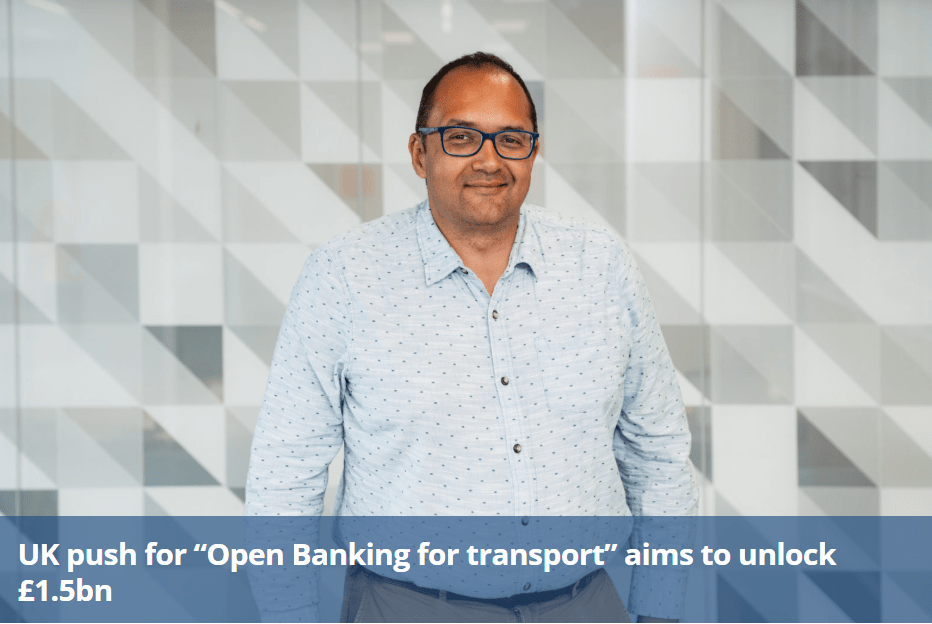
The UK is on the cusp of a significant transport data revolution. The Open Transport Initiative, dubbed the “Open Banking for transport,” aims to leverage user-permissioned, interoperable data to unlock over £1.5 billion* in national value annually. This push for a Transport Smart Data scheme across the entire UK means a fundamental step change in efficiency, user experience, and the fight against carbon emissions across the nation’s transport network.

Despite the immense potential of such a scheme (touching 60 million travellers and nearly 800 billion passenger kilometres each year) the UK transport sector remains incredibly fragmented. Unlike financial services, our sector’s data:

  1. Operates in silos (typically locked by both the mode of travel and the initial technology choices made by a handful of large system suppliers)
  2. Lacks unified and adopted standards for interoperable customer account sharing**
  3. fails to comply with the mandatory requirement for GDPOR data portability.

This all makes system integration difficult, limits commercial confidence and creates significant barriers to market entry.

We want to change that!

The article written our own Marcus Mayers in Cities Today explains further what we are up against and our plans:
https://cities-today.com/uk-push-for-open-banking-for-transport-aims-to-unlock-1-5bn/

*The estimated £1.5 billion annual value comes from potential outcomes like: lower commuter costs, reduced emissions, and improved accessibility. For example, achieving just a two percent shift from car to rail could cut 1.6 million tonnes of emissions yearly, while a one percent network efficiency gain could save around £1 billion.

** Although we have created and published our own free Open API Specification for Customer data sharing to help such adoption: https://opentransport.co.uk/open-standard/

Open Transport – example Use Cases

Use Cases are a helpful way of making things more understandable (especially technical solutions). We therefore often get asked for different Use Cases for our work, so we created the following examples:

  • UC1 : Consolidated Mobility Dashboard
    • UC1.1 : My Transport CO2
    • UC1.2 : My Transport CO2 + Actionable Insights
  • UC2 : Interoperable Transport Discounts
  • UC3 : Interoperable Vehicle Telematics
  • UC4 : Freight Tachograph Interoperability
  • UC5 : Automatic Multi-Modal Delay Repay

You can also see our short video explaining these example Use Cases in more detail.

All modes of transport & mobility

From the start or our work to standardise customer transport account data sharing, we have created a common definition of a modes of transport.

The 16 modes we currently recognise are:

  1. on foot
    for complete end-to-end journey mapping
  2. cycle
    includes both human-powered pedal cycle and ebike, typically rented or shared but also possibly privately owned for complete end-to-end journey mapping
  3. moped & motorbike
    shared & privately-owned self-powered vehicles, for complete end-to-end journey mapping
  4. scooter
    includes human and electric/battery powered where passenger steps in/on
  5. other micro-mobility
    includes Segway and any motorised self-balancing personal platform and also electric unicycles
  6. car
    includes any vehicle where the driver is also a passenger, such as: car / van vehicle rental, car pool & car club
  7. bus
    includes any vehicle typically greater than 8 seats.. such as a mini bus
  8. tram
    includes any guided vehicle such as a streetcar and also trolleybuses that are limited by overhead power lines
  9. metro & subway
    includes any light rail transit and their interconnecting systems
  10. train
    includes local overground services, funiculars, intercity, Eurostar / TGV, etc.
  11. water bus
    includes river buses, typically just passenger service, typically with multiple stops e.g. Thames Clipper
  12. water ferry
    includes passenger only and also passenger & vehicle water-based transport
  13. air
    includes aeroplane, helicopter, etc.
  14. car parking
    includes on-street & off-street
  15. taxi
    includes any non-commercial vehicle where the driver is NOT a passenger
  16. suspended cable car
    includes any aerial cable cars, such as London “Emirates Air Line” and New York Roosevelt Island Tramway

Mapping the Smart Data Transport Ecosystem

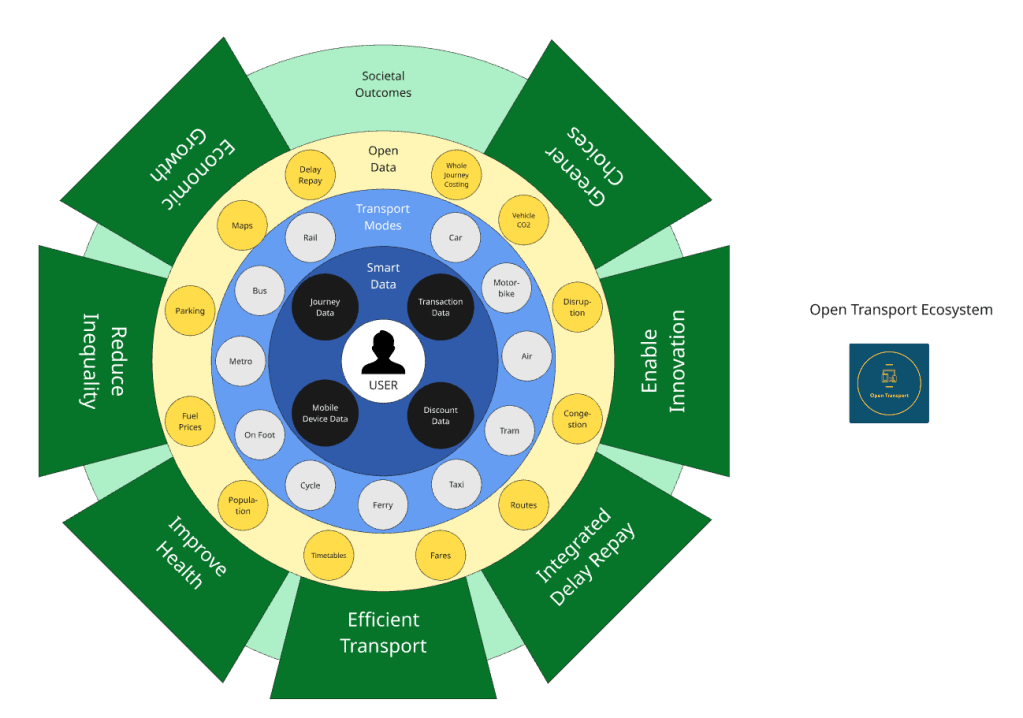
As part of of our efforts to explain the role of Smart Data across the Transport & Mobility sector, we have chosen to represent the ecosystem in a diagram.

Placing the user in the middle, this diagram aims to show that Smart Data for any mode of transport (Journey / Usage Data, Transaction Data, Discount & Concession Data and even associated Mobile Device Data – to validate where the user has been and to provide some idea of the modes they have used) and when combined with Open Data can help provide wider societal benefits such as:

  • Economic growth
  • Reduce inequality
  • Improve health
  • More efficiencies
  • Integrated Delay Repay (for any relevant mode)
  • Enable innvovation
  • Provide greener choices for the user

 if you would like to join or know more about the work of the Open Transport initiative please contact us: contact@opentransport.co.uk

Smart Data + Agentic AI + Transport = Another first for Open Transport

Those following our Smart Data Challenge journey will know that we are one of 10 finalists, given funds to develop a prototype to demonstrate that it is possible use multiple sources of transport and journey data, consumer financial data and Open Data for CO2 emissions of transport modes. Our dashboard provides a working personalised transport data product for customers to see all their information in a single place and then make informed, efficient travel decisions while minimising their environmental impact.

This is the first live release of any Smart Data product for the transport & mobility sector. It can now be accessed here: https://www.opentransport.org

In itself this is a major deliverable to launch in such a short amount of time (just 10 weeks). However we wanted to go even further with this project and address the “so what?” question that some people my ask.

So, in addition to all the functionality we have already developed (journey calculations, fuel transaction integration, individual user account login and the aggregation of multiple transport modes: rail, bus, metro / light rail& car) we have gone one major step forward… and also developed the first AI Agent application that uses an individual’s transport Smart Data to create actionable insights.

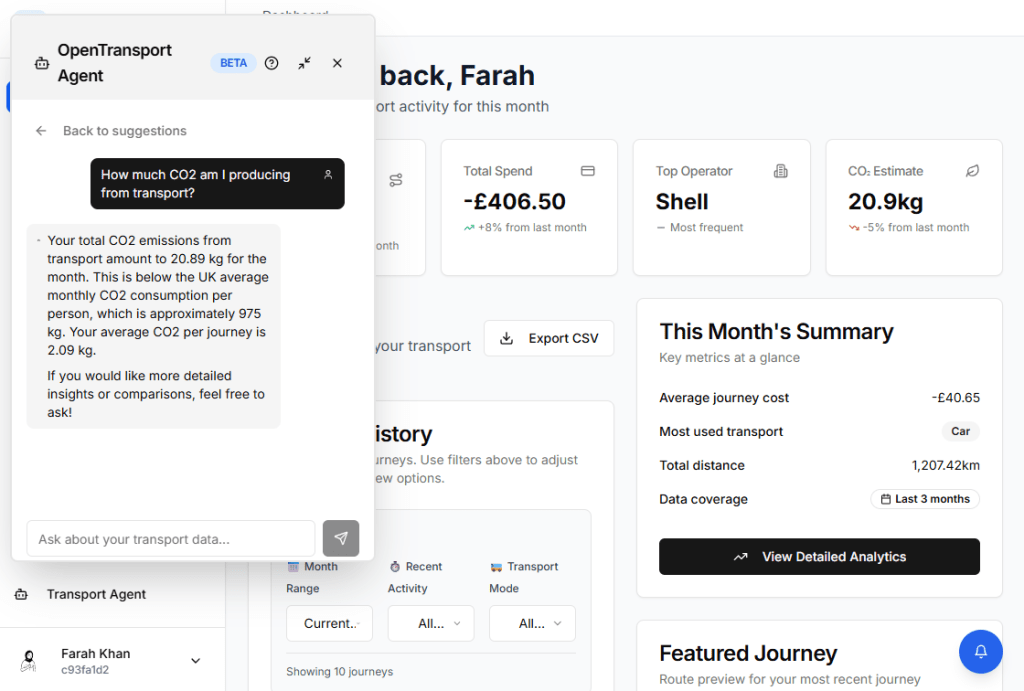
Our Open Transport Agent (yes, we know we probably need a more anthropomorphic name) creates concise analysis based upon a specific customer’s own transport data in the dashboard and generate useful recommendations – either via pre-written questions or a test box for users to make their own query.

Image of our Smart Data dashboard product showing the AI Agent answering a question about how much CO2 a user is producing based upon the data available.

if you would like to join or know more about the work of the Open Transport initiative please contact us: contact@opentransport.co.uk

Demonstrating our Smart Data Challenge prototype

This week we broke cover on what we have recently done for the Smart Data Challenge.

At the Smartex Limited Ticketing Card Forum [TCF] in Cardiff on Wednesday 24th September Hayden Sutherland demonstrated our Open Transport Smart Data Dashboard product to an audience of industry experts.

If you would like to see this product in action… contact us.

Smart Data 4 Transport

Open Transport is passionate about communicating our aims and activities. We have therefore created a monthly ‘Smart Data 4 Transport” (online) meeting that invites senior representatives from UK Government, including Department for Business & Trade, Department for Transport and Crown Commercial Service, as well as data and transport industry specialists and stakeholders such as ITS UK and The Open Data Institute.

This forum provides a consistent and transparent way of giving members of the transport & mobility sector and associated interested parties oversight on the progress of our work on the Smart Data Challenge and our plans for full Smart Data scheme adoption. It is also useful as a means of communicating any wider Smart Data ecosystem news and updates.

If you are interested in attending this call, please contact us:
contact@opentransport.co.uk

Smart Data Challenge – Information

The Open Transport Initiative is one of 10 finalists in the Smart Data Challenge.

Our prototype application uses multiple sources of transport and journey data, consumer financial data and open data around CO2 emissions of transport modes to create the first working personalised transport data dashboard for customers, to make informed, efficient travel decisions while minimising environmental impact.

The application is can be found at: https://www.opentransport.org/

If you would like more information contact@opentransport.co.uk